

Learning how to say face in Spanish is easier than you think. The most common word is cara, and it works in almost every Spanish-speaking country. This guide covers pronunciations, related words, common phrases, and fun tips to help you master Spanish vocabulary for the face quickly and confidently.
Key Takeaways
- Cara is the main Spanish word for face and is used across all Spanish-speaking regions.
- Understanding Spanish noun gender helps you use face-related words correctly in sentences.
- There are several facial expressions in Spanish that go beyond just the word face.
- Learning body parts in Spanish like face builds a strong foundation for everyday conversation.
- Pronunciation is straightforward, and this guide breaks it down step by step.
- Common Spanish phrases involving face make your conversations sound more natural.
- Practice tips and real-life examples help you remember and use these words confidently.
📑 Table of Contents
- How to Say Face in Spanish: A Complete and Easy Guide
- The Main Word: Cara
- Other Words for Face in Spanish
- Describing Parts of the Face in Spanish
- Facial Expressions in Spanish
- Face in Spanish Across Different Regions
- Tips to Remember Face Words in Spanish
- Common Mistakes to Avoid
- Putting It All Together
- Conclusion
How to Say Face in Spanish: A Complete and Easy Guide
Have you ever found yourself in a conversation and needed to say face in Spanish but didn’t know how? You are not alone. Millions of people start learning Spanish every day, and the word for face is one of the first things they need. The good news is that it is simple, fun, and easy to remember.
The main Spanish word for face is cara. It is used in Spain, Mexico, Argentina, and almost every Spanish-speaking country on Earth. Whether you are traveling, chatting with a friend, or just building your Spanish vocabulary, knowing how to say face opens doors to better conversations. This guide will walk you through everything you need to know, from basic translations to real-life examples and handy tips.
By the end of this article, you will feel confident using face-related words in Spanish. You will also learn how to describe facial features, talk about expressions, and sound more natural in everyday Spanish conversation. Let us dive right in.
The Main Word: Cara
The word cara is the most common way to say face in Spanish. It is a feminine noun, which means you will often pair it with the article la (the). For example, you would say la cara when talking about the face. This is important because Spanish noun gender affects how adjectives and articles work in a sentence.
How to Pronounce Cara
Pronouncing cara is very easy. It sounds like kah-rah. The first syllable sounds like the English word car, but shorter. The second syllable sounds like rah with a soft a. Here is a simple breakdown:
- Car — sounds like the English word car, but drop the r sound at the end.
- A — say ah, like when a doctor asks you to open your mouth.
Put them together and you get kah-rah. Practice saying it a few times out loud. Once it feels natural, you are ready to use it in real sentences.
Common Sentences Using Cara
Here are some easy sentences to help you practice:
- Me lavo la cara — I wash my face.
- Tiene una cara hermosa — She has a beautiful face.
- Me duele la cara — My face hurts.
- Lava tu cara todos los días — Wash your face every day.
- La cara está roja — The face is red.
Notice how la cara stays the same in every sentence. That is because cara is always feminine. This consistency makes it one of the easiest body part words to learn in Spanish.
Other Words for Face in Spanish
While cara is the most common word, Spanish has a few other ways to refer to the face depending on the context. Learning these variations will make your Spanish vocabulary richer and more natural.
Rostro
Rostro is another word for face in Spanish. It is a bit more formal than cara and is often used in writing or in more serious descriptions. For example, you might read el rostro de la mujer (the face of the woman) in a book or article.
Rostro is also used when talking about someone’s facial expression or when describing a person’s appearance in a poetic or respectful way. It is a great word to add to your Spanish dictionary because it shows a higher level of language skill.
Faz
Faz is a less common but still useful word for face. It is often used in literary or formal contexts. You might hear la faz de la tierra (the face of the earth) when someone is describing landscapes or surfaces. For everyday conversation, cara and rostro are the words you will use most often.
Quick Comparison Table
| Word | Meaning | When to Use It |
|---|---|---|
| Cara | Face | Everyday conversation, most common |
| Rostro | Face (formal) | Writing, formal speech, descriptions |
| Faz | Face (literary) | Books, poetry, formal texts |
For most learners, focusing on cara is the best approach. It is understood everywhere, and you will use it in daily Spanish conversation more than any other word for face.
Describing Parts of the Face in Spanish
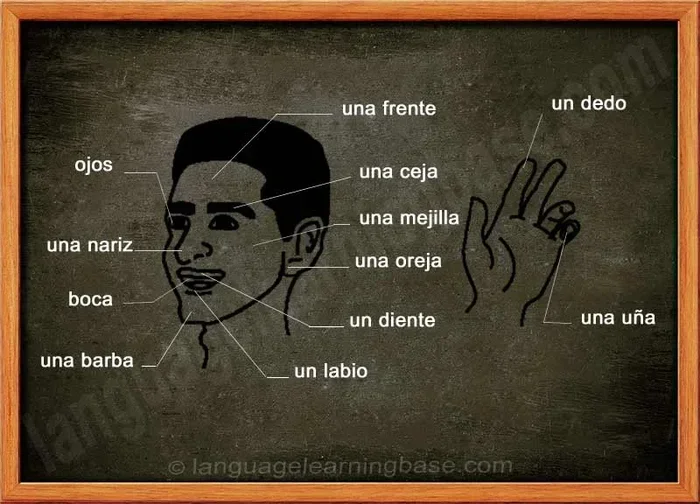
Once you know how to say face in Spanish, the next step is learning the parts of the face. This is a fun and practical part of Spanish vocabulary that helps you describe people, animals, and even yourself in conversations.
Key Face Parts and Their Spanish Names
- Ojos — Eyes. Me gustan tus ojos. (I like your eyes.)
- Nariz — Nose. Tiene una nariz grande. (He has a big nose.)
- Boca — Mouth. Cierra la boca. (Close your mouth.)
- Orejas — Ears. Sus orejas son grandes. (His ears are big.)
- Cejas — Eyebrows. Levanta las cejas. (Raise your eyebrows.)
- Dientes — Teeth. Sonríe y muestra los dientes. (Smile and show your teeth.)
- Barbilla — Chin. Toca tu barbilla. (Touch your chin.)
- Mejillas — Cheeks. Sus mejillas están rosadas. (His cheeks are rosy.)
- Frente — Forehead. Suda en la frente. (He sweats on the forehead.)
Learning these face parts in Spanish is one of the fastest ways to build your Spanish language basics. You can use them when describing people, telling stories, or even giving directions in a mirror during a language lesson.
Practice Tip: Describe Your Own Face
Try looking in a mirror and describing your face in Spanish. Say things like Tengo ojos marrones (I have brown eyes) or Mi nariz es pequeña (My nose is small). This simple exercise helps you remember the words faster and builds confidence for real conversations.
Facial Expressions in Spanish
Knowing how to say face in Spanish is just the beginning. People use their faces to express emotions, and learning facial expressions in Spanish makes your language skills much more useful. Here are some common expressions and how to say them in Spanish.
Common Expressions Involving the Face
- Sonreír — To smile. Sonríe y tu cara brilla. (Smile and your face shines.)
- Fruncir el ceño — To frown. No frunzas el ceño. (Don’t frown.)
- Abrir los ojos — To open your eyes. Abre los ojos de par en par. (Open your eyes wide.)
- Poner una cara de sorpresa — To make a surprised face. Puso una cara de sorpresa. (He made a surprised face.)
- Enrojecerse de vergüenza — To blush with shame. Se puso roja la cara de vergüenza. (Her face turned red with shame.)
These expressions are incredibly useful in daily life. When you learn how to describe what someone’s face is doing, you can have much richer Spanish conversations. Native speakers use these phrases all the time, so knowing them will make you sound more natural and fluent.
Fun Fact: Face Idioms in Spanish
Spanish has some fun idioms that use the word face. For example, dar la cara means to face something or to show courage. Another one is hacer caras, which means to make faces, usually at children. These idioms are a great way to sound more like a native speaker and add color to your language skills.
Face in Spanish Across Different Regions
One of the beautiful things about Spanish is that it is spoken in many countries, and the word for face stays mostly the same. However, there are slight differences in how people use it depending on where they are from.
Latin American Spanish vs. European Spanish
In Latin American Spanish, cara is used exactly the same way as in Spain. You will hear it in Mexico, Colombia, Argentina, Chile, and every other Latin American country. The pronunciation might sound a little different depending on the region, but the word itself does not change.
In European Spanish, also called Castilian Spanish, cara is also the standard word for face. Some speakers in Spain might use rostro more often in formal writing, but in everyday speech, cara is king. So no matter where you travel, cara will always work.
Do You Need to Worry About Regional Differences?
The short answer is no. Face translates to cara everywhere. You do not need to learn a different word for each country. Focus on mastering cara first, and then you can explore rostro and faz as you advance in your Spanish learning tips journey.
Tips to Remember Face Words in Spanish
Learning new vocabulary can be tricky, but these simple tips will help you remember how to say face and related words in Spanish for the long term.
1. Use Flashcards
Write the Spanish word on one side and the English meaning on the other. Review them every day. Apps like Anki or Quizlet make this easy and fun. Seeing the word cara every day will help it stick in your memory.
2. Practice with Real People
Find a language partner or join a Spanish conversation group. Practice saying me lavo la cara or tengo los ojos cansados out loud. Speaking with real people builds confidence and improves your Spanish pronunciation faster than studying alone.
3. Watch Spanish Videos
Watch shows or videos in Spanish and pay attention to how people describe faces and emotions. You will hear words like cara, ojos, and sonrisa used naturally. This is one of the best Spanish language basics practice methods.
4. Label Things Around You
Put sticky notes with Spanish words on mirrors, windows, and other surfaces. Write cara on your bathroom mirror. Every time you look in the mirror, you will see and remember the word. This simple trick works surprisingly well for building everyday Spanish words memory.
5. Connect to What You Already Know
If you know any other languages, look for similarities. The word cara sounds a bit like the English word care, and both have to do with how you present yourself to others. Making these connections helps your brain remember new words faster and makes learning Spanish more enjoyable.
Common Mistakes to Avoid
When learning how to say face in Spanish, some common mistakes can slow you down. Here are a few to watch out for.
- Forgetting the article. Always say la cara, not just cara, when you mean the face. The article makes your sentences sound more natural.
- Mixing up cara and cerebro. Cara means face, while cerebro means brain. Do not confuse the two.
- Using faz too often. Faz is rare in everyday speech. Stick with cara for most situations.
- Ignoring gender agreement. Since cara is feminine, use adjectives that match. Say la cara bonita, not la cara bonito.
- Practicing too little. Consistency beats intensity. Ten minutes of daily practice is better than one long session per week.
Avoiding these mistakes will help you build good habits from the start and make your Spanish translation skills more accurate.
Putting It All Together
Now that you know how to say face in Spanish, it is time to put everything into practice. Start with cara as your main word. Then learn the parts of the face like ojos, nariz, and boca. Practice the facial expressions and try using them in real sentences every day.
Remember that every language learner starts somewhere. The fact that you are learning how to say face in Spanish shows you are on the right path. Keep practicing, stay curious, and do not be afraid to make mistakes. That is how real learning happens.
If you are also interested in learning more Spanish pet names or want to explore how animals are named in Spanish, you might enjoy our guides on Spanish cat names and Spanish rabbit names. These fun articles will help you expand your animal vocabulary while building your confidence in Spanish.
Another interesting topic to explore is how certain words carry meaning in context. If you want to understand more about how words and phrases work in their original setting, check out our article on in situ meaning to learn how context shapes the way we use language, including Spanish.
Learning a language is a journey, and every new word you add brings you one step closer to fluency. The word cara is just the beginning. Keep going, keep practicing, and enjoy the process of mastering Spanish for beginners. You have got this!
Conclusion
Learning how to say face in Spanish is a simple but important step in your language journey. The word cara is your go-to translation, and it works everywhere Spanish is spoken. You also learned about rostro, faz, parts of the face, facial expressions, and regional differences. These Spanish vocabulary building blocks will serve you well in conversations, reading, and writing.
Use the tips and practice exercises in this guide to make your learning stick. Focus on pronunciation, use flashcards, and practice with real people whenever you can. The more you use these words, the more natural they will feel. Keep exploring, keep practicing, and most importantly, have fun with your Spanish language journey. Every word you learn brings you closer to fluency and deeper connections with Spanish speakers around the world.
Frequently Asked Questions
What is the most common word for face in Spanish?
The most common word for face in Spanish is cara. It is used in every Spanish-speaking country and is the first word most learners memorize when studying body parts in Spanish.
Is cara masculine or feminine in Spanish?
Cara is a feminine noun in Spanish. This means you should use the feminine article la before it, as in la cara. Adjectives that describe it should also be feminine, like la cara bonita.
Can I use rostro instead of cara?
Yes, you can use rostro, but it is more formal than cara. Rostro is often found in writing, literature, or formal descriptions. For everyday conversation, cara is the better and more widely used choice.
How do you say face in Latin American Spanish?
The word for face in Latin American Spanish is the same as in European Spanish: cara. There are no regional differences for this word, making it one of the easiest and most universal terms to learn.
What are some easy Spanish phrases using the word face?
Some easy phrases include Me lavo la cara (I wash my face), Tiene una cara hermosa (She has a beautiful face), and Me duele la cara (My face hurts). These are practical phrases you can use right away in basic Spanish conversation.
How can I remember Spanish face words more easily?
Use flashcards, practice in front of a mirror, and label items around your home with Spanish words. Watching Spanish videos and speaking with language partners also helps reinforce your memory. Consistency is the key to making these Spanish language basics stick.



