
Learning how to say what time is it in Spanish is one of the most useful skills for any beginner. This guide breaks down the core rules, essential phrases, and regional differences so you can tell time confidently in any Spanish-speaking country. You will also discover common mistakes to avoid and pro tips that make you sound like a local.
Have you ever found yourself in a Spanish-speaking country, completely lost on what time it is? Maybe you missed a bus or arrived late to a meeting because you could not figure out the local clock. You are not alone. Learning how to say what time is it in Spanish is one of the first things every language learner needs. It opens doors to real conversations and helps you navigate daily life with confidence.
The good news is that telling time in Spanish is simpler than it looks. Once you understand a few basic rules and phrases, you will be asking and answering time questions like a pro. This guide walks you through everything step by step. We cover numbers, formulas, common expressions, and even regional differences that trip up many learners.
By the end of this article, you will know exactly how to ask for the time, how to give the time, and how to handle tricky situations like half-hours and quarters. Let us dive in and make this easy and fun.
Key Takeaways
- Master the basic formula: “Es la” for 1:00 and “Son las” for all other hours.
- Learn key Spanish numbers: You only need 1 through 12 to tell time fluently.
- Use “media” and “cuarto”: These words replace “half” and “quarter” in Spanish time expressions.
- Know AM and PM equivalents: “De la mañana,” “de la tarde,” and “de la noche” are essential.
- Regional differences matter: Spain and Latin America use slightly different phrasing and clock formats.
- Practice with real conversations: Using phrases in context builds speed and confidence faster than memorization alone.
📑 Table of Contents
- Why Knowing How to Say What Time Is It in Spanish Matters
- The Spanish Numbers You Need to Tell Time
- How to Say What Time Is It in Spanish: The Core Formula
- Essential Spanish Time Expressions You Will Hear Every Day
- AM and PM in Spanish: Morning, Afternoon, and Night
- Regional Differences: Spain vs Latin America
- Common Mistakes to Avoid When Telling Time in Spanish
- Quick Tips to Sound Like a Local
- Final Thoughts
Why Knowing How to Say What Time Is It in Spanish Matters
Time is part of every conversation. Whether you are catching a train, meeting friends, or ordering food at a specific hour, you need to know the time. In Spanish-speaking countries, schedules can work a bit differently than what you are used to. Lunch might be at 2:00 PM, and dinner could start at 10:00 PM. Understanding these rhythms starts with mastering Spanish time vocabulary.
Beyond practical uses, telling time shows respect for the culture. When you make the effort to speak even basic Spanish, people notice. It builds trust and opens up warmer interactions. Imagine walking into a café in Madrid and confidently asking, ¿Qué hora es? The barista smiles, and suddenly you feel like part of the place. That is the power of learning how to say what time is it in Spanish.
Also, time expressions appear everywhere in daily Spanish. News broadcasts, TV schedules, and even casual chats rely heavily on clock language. If you want to improve your overall fluency, start with time. It is one of the highest-frequency topics in everyday conversation.
The Spanish Numbers You Need to Tell Time
Before you can tell time, you need the numbers. The great thing is that you only need 1 through 12 for basic clock reading. Here is a quick look at the numbers you will use most.
Numbers 1 Through 12 in Spanish
- 1 – Uno (oon-oh)
- 2 – Dos (dohs)
- 3 – Tres (trays)
- 4 – Cuatro (kwah-troh)
- 5 – Cinco (seen-koh)
- 6 – Seis (sayce)
- 7 – Siete (see-eh-teh)
- 8 – Ocho (oh-choh)
- 9 – Nueve (nweh-beh)
- 10 – Diez (dee-eth)
- 11 – Once (ohn-seh)
- 12 – Doce (doh-seh)
You do not need to memorize all higher numbers right away. For now, focus on these twelve. They cover every hour on the clock. If you already know these, you are halfway to mastering how to say what time is it in Spanish.
Quick tip: practice saying these numbers out loud. Repetition helps your tongue get used to the sounds. Try counting to twelve every morning while you make coffee. It sounds small, but it builds real fluency over time.
How to Say What Time Is It in Spanish: The Core Formula
Now let us get to the heart of the matter. The basic structure for telling time in Spanish follows a simple pattern. You use the verb “ser” (to be) combined with the hour and any extra minutes.
For 1:00 — Use “Es la”
When the hour is exactly one, you say “Es la” followed by the hour. The word “la” is used because “hora” (hour) is a feminine noun.
- 1:00 — Es la una (ess lah oo-nah)
- 1:15 — Es la una y cuarto (ess lah oo-nah ee kwahr-toh)
- 1:30 — Es la una y media (ess lah oo-nah ee meh-dee-ah)
For All Other Hours — Use “Son las”
For every hour except one, you use “Son las”. This is the plural form because the hour is more than one.
- 2:00 — Son las dos (sohn lahs dohs)
- 3:00 — Son las tres (sohn lahs trays)
- 6:00 — Son las seis (sohn lahs sayce)
- 12:00 — Son las doce (sohn lahs doh-seh)
That is really all there is to it for exact hours. The formula is straightforward and predictable. Once you internalize “Es la” for one and “Son las” for everything else, you have the foundation down.
Adding Minutes
To add minutes, you use the word “y” which means “and.” Then you state the minutes after the hour.
- 3:10 — Son las tres y diez (sohn lahs trays ee dyece)
- 5:25 — Son las cinco y veinticinco (sohn lahs seen-koh ee vaynt-seehn-koh)
- 9:40 — Son las nueve y cuarenta (sohn lahs nweh-beh ee kwah-rehn-tah)
Notice how natural it feels. You are simply combining the hour and the minutes with “y.” This makes telling time in Spanish one of the easiest grammar patterns to pick up.
Essential Spanish Time Expressions You Will Hear Every Day
Native speakers do not always say the exact hour and minutes. They use shorthand expressions that make conversations faster and smoother. Here are the most common ones you should know.
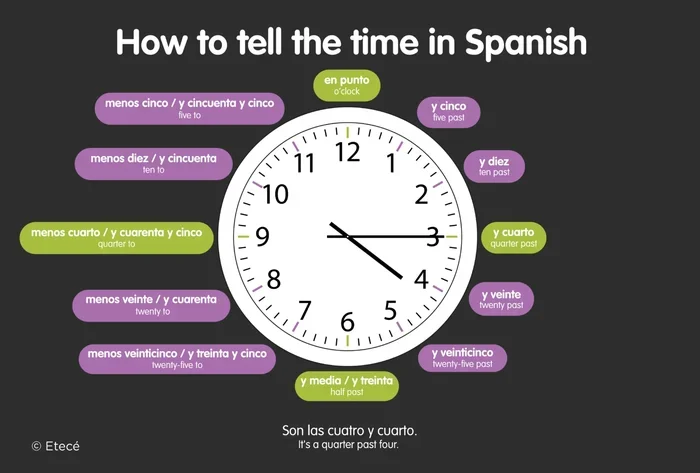
Media — Half Past
The word “media” means “half.” You use it after “y” to say half past the hour.
- 1:30 — Es la una y media (it is one-thirty)
- 4:30 — Son las cuatro y media (it is four-thirty)
- 7:30 — Son las siete y media (it is seven-thirty)
Cuarto — Quarter Past
The word “cuarto” means “quarter” or “fifteen.” Use it for times that are 15 minutes past the hour.
- 2:15 — Son las dos y cuarto (it is two-fifteen)
- 8:15 — Son las ocho y cuarto (it is eight-fifteen)
- 11:15 — Son las once y cuarto (it is eleven-fifteen)
Menos — Minutes to the Next Hour
When the minutes are closer to the next hour, Spanish speakers often count backward. The word “menos” means “minus” or “to.”
- 1:45 — Son las dos menos cuarto (it is two minus a quarter, meaning fifteen to two)
- 3:50 — Son las cuatro menos diez (it is four minus ten, meaning fifty past three)
- 9:45 — Son las diez menos cuarto (it is ten minus a quarter, meaning fifteen to ten)
This might feel tricky at first, but it makes perfect sense once you practice it a few times. Native speakers use “menos” all the time, so it is worth adding to your Spanish time vocabulary right away.
More Useful Time Phrases
Beyond the clock math, here are phrases you will use in real life every single day:
- ¿Qué hora es? — What time is it?
- ¿A qué hora…? — At what time…?
- Es mediodía — It is noon
- Es medianoche — It is midnight
- Temprano — Early
- Tarde — Late
- Ahora — Now
- En punto — On the dot (exact hour)
These phrases appear in almost every conversation about schedules and plans. Bookmark them. They are pure gold for anyone learning how to say what time is it in Spanish.
AM and PM in Spanish: Morning, Afternoon, and Night
English uses AM and PM to distinguish morning from evening. Spanish takes a different approach. Instead of abbreviations, it uses descriptive phrases that tell you exactly when something happens. This system is elegant and easy to learn.
De la Mañana — Morning (AM)
Use “de la mañana” for times from midnight to noon. This covers the early morning and late morning hours.
- 8:00 AM — Son las ocho de la mañana
- 11:30 AM — Son las once y media de la mañana
De la Tarde — Afternoon (PM)
Use “de la tarde” for times from noon until around sunset. This covers the afternoon and early evening.
- 2:00 PM — Son las dos de la tarde
- 5:45 PM — Son las seis menos cuarto de la tarde
De la Noche — Night/Evening (PM)
Use “de la noche” for times from sunset until midnight. This covers the evening and late night.
- 8:00 PM — Son las ocho de la noche
- 11:00 PM — Son las once de la noche
Some speakers also use “de la madrugada” for the very early hours, like 3:00 AM to 6:00 AM. This word refers to the dark hours just before dawn.
One interesting thing to note: the concept of time has deep roots in many cultures. If you are curious about broader perspectives on time, you might enjoy exploring the meaning of life and how different cultures view time and existence.
The key takeaway is simple. Add the time-of-day phrase after the clock time, and you instantly make your Spanish sound more natural and fluent.
Regional Differences: Spain vs Latin America
Spanish is spoken across many countries, and small differences exist in how people talk about time. Understanding these variations helps you sound more natural no matter where you are.
Spain — The 24-Hour Clock
In Spain, people commonly use the 24-hour clock format in everyday speech and on schedules. Instead of saying “3:00 PM,” they say “las quince horas.”
- 3:00 PM — Son las quince (sohn lahs keehn-koh)
- 9:00 PM — Son las veintiuno (sohn lahs vaynt-ee-oo-noh)
- 12:00 AM — Son las cero horas (sohn lahs seh-roh oh-rahs)
If you visit Spain, getting comfortable with the 24-hour system will save you a lot of confusion. Train schedules, movie listings, and TV guides all use this format.
Latin America — The 12-Hour Clock
In most Latin American countries, the 12-hour clock is standard. People use “de la mañana,” “de la tarde,” and “de la noche” just like we covered above. The 24-hour format appears in formal or written contexts, but spoken Spanish usually sticks with the 12-hour style.
Also, in some regions, people use slightly different words for quarters and halves. For example, in Mexico, you might hear “catorce” (fourteen) used loosely for “a quarter” in casual speech, though “cuarto” remains the standard. These small differences add flavor and charm to the language.
Common Mistakes to Avoid When Telling Time in Spanish
Even motivated learners make mistakes with time. Here are the most common ones and how to avoid them.
Using “Es” for Hours Other Than One
The biggest mistake is saying “Es la dos” instead of “Son las dos.” Remember: only use “Es la” for the hour of one. For every other hour, always use “Son las.”
Forgetting the Gender of “Hora”
“Hora” is a feminine noun, which is why you say “la una” and “las dos.” Mixing up the gender leads to awkward phrasing. Keep “la” with one and “las” with everything else.
Confusing “Media” and “Cuarto”
“Media” means half (30 minutes). “Cuarto” means quarter (15 minutes). Do not mix them up. A quick trick: “media” has the word “mid” in it, reminding you it is the halfway point.
Omitting the Time-of-Day Phrase
Skipping “de la mañana,” “de la tarde,” or “de la noche” can cause confusion, especially for times like 1:00 PM or 8:00 PM. Always include the time-of-day phrase for clarity.
Avoiding these mistakes will sharpen your skills fast. The more you practice, the more natural it becomes. You can even test yourself by looking at a clock and saying the time out loud in Spanish throughout your day.
Quick Tips to Sound Like a Local
Want to take your time-telling skills to the next level? Try these practical tips that native speakers love.
- Talk to a clock: Look at any clock during your day and say the time in Spanish. Do this five times a day for one week.
- Set your phone to Spanish: Changing your phone language immerses you in Spanish time expressions every time you glance at the screen.
- Watch Spanish TV with subtitles: Notice how characters mention the time in real dialogue. This builds natural listening skills.
- Practice with a language partner: Ask a friend or tutor to quiz you on random times. Speed matters in real conversations.
- Use time-related pet names for fun: If you have a cat, you might even try naming it something Spanish like “Reloj” (clock) or “Tic Tac” to reinforce your learning. You can find more ideas in our guide on Spanish cat names for creative inspiration.
These small habits add up quickly. Within a few weeks, telling time in Spanish will feel automatic and effortless.
Final Thoughts
Learning how to say what time is it in Spanish is a practical and rewarding skill. It gives you independence when traveling, builds your confidence in conversations, and deepens your connection to Spanish-speaking cultures. The formulas are simple, the expressions are useful, and the regional differences add interesting depth to your learning journey.
Start with the basic formula. Master the numbers 1 through 12. Add “media,” “cuarto,” and “menos” for flexibility. Then layer in the time-of-day phrases to make your Spanish sound polished and natural. Practice a little every day, and you will be telling time like a local before you know it.
Remember, every fluent speaker started exactly where you are now. The fact that you are taking the time to learn this shows real dedication. Keep going, stay curious, and enjoy the process.
And if you love the idea of using Spanish names in everyday life, you might also enjoy exploring our list of Spanish teddy bear names for a fun way to bring the language into your home. Similarly, if you have a pet rabbit, check out our Spanish rabbit names for adorable options that keep the Spanish learning spirit alive.
Time is precious. Use it wisely, and your Spanish skills will grow faster than you ever expected.
Frequently Asked Questions
What is the simplest way to ask the time in Spanish?
The easiest and most common way is to say ¿Qué hora es? which means “What time is it?” You can also use ¿Me dices la hora? which is a softer, more casual way to ask someone for the time. Both are understood everywhere in the Spanish-speaking world.
Do I need to learn the 24-hour clock to tell time in Spanish?
It depends on where you are. In Spain, the 24-hour clock is used daily, so learning it helps a lot. In Latin America, the 12-hour clock with “de la mañana” and “de la tarde” is more common. You do not need both right away. Start with the 12-hour format and add the 24-hour system as you grow more comfortable.
How do I say 12:30 PM in Spanish?
You say Son las doce y media de la tarde. This translates to “It is twelve-thirty in the afternoon.” The word “media” means half, and “de la tarde” tells your listener it is the afternoon time.
Is there a difference between “tiempo” and “hora” in Spanish?
Yes, there is an important distinction. “Hora” refers to a specific time on the clock, like 3:00 or 7:15. “Tiempo” means time in a broader sense, like weather (“¿Qué tiempo hace?”) or the general concept of time. When asking for the clock time, always use “hora,” not “tiempo.”
Can I use these time phrases in any Spanish-speaking country?
Absolutely. The core time expressions work across all Spanish-speaking countries from Spain to Argentina to Mexico. There may be slight regional preferences, like the 24-hour clock in Spain or specific slang in certain areas, but the basics remain the same everywhere.
How long does it take to learn to tell time in Spanish fluently?
Most learners can master the basics within a few days of regular practice. The formula is simple, and the key expressions are short and easy to remember. To feel truly fluent and comfortable in real conversations, give yourself a couple of weeks of daily practice. Consistency matters more than speed.