

Learning how to say day in French is simple and fun. The French word for day is jour, and it opens the door to everyday conversations, telling time, and understanding French culture. This guide gives you quick tips, pronunciation tricks, and real-life examples to build your French vocabulary fast.
Key Takeaways
- Jour is the French word for day and is one of the most used words in daily French.
- Knowing how to say day in French helps you tell time, make plans, and chat naturally.
- Pronunciation is straightforward once you learn the basic French vowel sounds.
- Days of the week, months, and common phrases all revolve around the word jour.
- practicing with real-life examples speeds up your learning and builds confidence.
- Common mistakes like confusing jour and journée are easy to avoid with clear guidance.
- Internal cultural context, such as understanding in situ meaning, helps you grasp how French words fit into real conversations.
📑 Table of Contents
- How to Say Day in French: Your Quick Beginner Guide
- The French Word for Day: Jour
- Days of the Week in French
- Common Phrases Using the Word Day
- Day vs. Daytime: Jour vs. Journée
- Fun Cultural Facts About the Word Day in French
- Quick Tips to Remember the Word Jour
- Common Mistakes Beginners Make with Jour
- How to Practice Saying Day in French Every Day
- Conclusion: Start Using Jour Today
How to Say Day in French: Your Quick Beginner Guide
So you want to learn how to say day in French? Great news! It is one of the first words you should know. The French word for day is jour (pronounced like “joor”). It sounds simple, right? But there is so much more to explore. From telling time to talking about your daily routine, jour shows up everywhere in the French language.
Whether you are planning a trip to Paris or just curious about French vocabulary, mastering this word is a smart move. It is short, common, and incredibly useful. In this guide, we will walk you through everything you need to know. You will learn the pronunciation, the different forms, and how to use jour in real sentences. Let us dive in!
The French Word for Day: Jour
The word jour means day in French. It is a masculine noun, which means it pairs with the article “le” (the). So “the day” in French is le jour. This is one of those words that you will hear in situ — that is, in real French conversations — almost every single day. Understanding how words work in their original context helps you pick up French much faster.
Here are some quick facts about jour:
- French word: jour
- Pronunciation: “joor” (the “j” sounds like the English “j” in “jump”)
- Gender: Masculine (le jour)
- Plural: jours (days)
- Common phrases: bonjour (good day), demain (tomorrow), aujourd’hui (today)
Notice how jour appears in bonjour, one of the most famous French greetings. It literally means “good day.” Once you know jour, you unlock a whole family of common words. This is why learning how to say day in French is such a powerful first step.
Pronouncing Jour Correctly
Pronunciation matters a lot in French. The good news is that jour is easy to say. Start with the letter “j.” In French, “j” makes a soft “zh” sound, similar to the “s” in “measure.” Then add the vowel “our,” which sounds like the “oor” in “moor.” Put them together, and you get “joor.”
Here are some tips to nail the pronunciation:
- Do not roll your “r” too strongly. Keep it soft and gentle.
- The “j” should never sound like the English “j” in “jam.” It is softer.
- Practice saying “joor” slowly, then speed up as you feel comfortable.
- Listen to native speakers on apps or videos to train your ear.
If you want to go deeper into how French words fit naturally into real speech, check out our guide on in situ meaning. It explains why words sound different in context, which is exactly what happens with jour in everyday French.
Days of the Week in French
Now that you know jour, let us build on it. The days of the week in French are essential for scheduling, making plans, and sounding natural. Each day has its own unique name, and many are linked to jour or other common roots.
| English | French | Pronunciation |
|---|---|---|
| Monday | Lundi | Lun-dee |
| Tuesday | Mardi | Mar-dee |
| Wednesday | Mercredi | Mer-cruh-dee |
| Thursday | Jeudi | Zhuh-dee |
| Friday | Vendredi | Vahn-druh-dee |
| Saturday | Samedi | Sahm-dee |
| Sunday | Dimanche | Dee-mahnsh |
Notice something interesting? Most of these days end in “-di,” which comes from the Latin word for day. This is a great pattern to remember. When you learn jour, you also unlock the logic behind the days of the week. It is like a secret code for French language basics.
Also, in French, the week starts on Monday, not Sunday. This is different from English and something many beginners overlook. Keep this in mind when making plans or reading a French calendar.
Common Phrases Using the Word Day
Knowing jour alone is helpful, but using it in phrases is where the magic happens. Here are some everyday expressions that every beginner should know:
- Bonjour — Good day / Hello
- Bonne journée — Have a good day
- Toute la journée — All day long
- Un jour — One day / Someday
- Chaque jour — Every day
- Le jour même — The very day
- Jour et nuit — Day and night
These phrases pop up in real conversations all the time. When you greet someone with a warm bonjour, you are already using the word jour. And when someone wishes you bonne journée, you know exactly what it means — have a good day.
Try using at least one of these phrases in your next practice session. Even a simple bonjour will make a big difference. It shows respect and effort, which French people truly appreciate.
How to Use Jour in Sentences
Let us look at some practical examples. Here are simple sentences you can start using right away:
- Je me lève chaque jour. — I wake up every day.
- Quelle est la date d’aujourd’hui? — What is today’s date? (This uses aujourd’hui, which means today.)
- Bonne journée à tous! — Have a good day, everyone!
- Un jour, je parlerai français couramment. — One day, I will speak French fluently.
- Le soleil se lève avec le jour. — The sun rises with the day.
See how natural these feel? You do not need complex grammar to start using jour in real conversations. Start with one phrase, practice it daily, and build from there.
Day vs. Daytime: Jour vs. Journée
Here is a tricky part for beginners. French has two words that both relate to “day”: jour and journée. They are not exactly the same, and understanding the difference will level up your French.
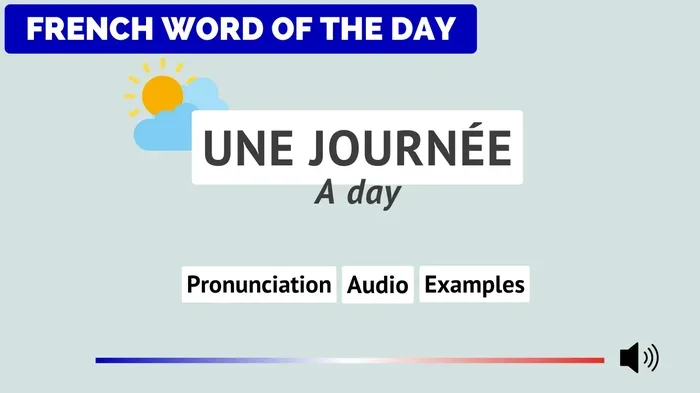
Jour refers to the concept of day as a unit of time. Think of it as the 24-hour period or the daylight hours. Journée refers to the duration of the day, especially how you spend it. It is more about your experience of the day.
Here is a quick comparison:
- Le jour — the day (as a time unit, a calendar day)
- La journée — the day (as a period of time, how the day goes)
- Un jour — one day / someday
- Une journée — a full day (of activity)
For example, “Il fait beau jour” means “It is nice during the day” (referring to daylight). But “J’ai passé une bonne journée” means “I had a good day” (referring to your experience). Once you see the difference, it clicks into place.
This kind of nuance is exactly why learning French vocabulary in context matters. Words like jour and journée might look similar, but they carry different shades of meaning. Paying attention to these details will make your French sound much more natural.
Fun Cultural Facts About the Word Day in French
French culture is full of interesting connections to the word jour. Learning these fun facts makes studying more enjoyable and helps you remember the word better.
Did you know that many French cat names are inspired by daily life and the calendar? For instance, you might find a cat named Jour or Dimanche in a French household. If you are curious about naming pets in French, our guide on French cat names is a fun read that connects language to culture.
Another cool fact: the word aujourd’hui (today) is actually a contraction. It comes from “à le jour d’hui,” which literally means “on the day of today.” Over centuries, French speakers shortened it to what we use now. Language is always evolving, and that is part of what makes learning French so exciting.
Also, the French greeting bonjour is used far more than just a simple hello. It is a cultural norm. When you walk into a shop, a café, or even pass a neighbor on the street, a quick bonjour is expected. It sets a friendly tone and shows good manners. So knowing how to say day in French gives you a key social tool as well.
Quick Tips to Remember the Word Jour
Memory tricks can make learning feel effortless. Here are some tried-and-true tips to help you remember jour and its related words:
- Visualize a journey. The word jour sounds like “journey.” Every day is a new journey, so connect the two in your mind.
- Use it every morning. Say bonjour out loud each morning. Repetition builds strong memory.
- Write it down. Keep a small notebook of French words. Writing jour five times a day reinforces learning.
- Set phone reminders. Label times of day in French on your phone. “Morning jour,” “Evening journée,” and so on.
- Watch French content. Movies, shows, and YouTube videos expose you to jour in natural settings. This is learning in situ, just like understanding in situ meaning helps you grasp word usage in real life.
The key is consistency. You do not need to study for hours. Just a few minutes each day, and you will see progress. Before long, jour will feel like a natural part of your vocabulary.
Common Mistakes Beginners Make with Jour
Everyone makes mistakes when learning a new language. The good news is that most errors with jour are easy to avoid. Here are the most common ones:
- Confusing jour and journée. Remember, jour is about the time unit, and journée is about your experience of the day.
- Using the wrong article. Jour is masculine, so it is always le jour or un jour. Never use “la” with it.
- Pronouncing the “j” too hard. Keep it soft, like a gentle “zh” sound, not a hard “j” like in English.
- Forgetting that the week starts on Monday. This trips up many English speakers who are used to Sunday being the first day.
- Overcomplicating things. You do not need to memorize every phrase at once. Start with bonjour and build from there.
Avoiding these mistakes will save you a lot of frustration. Focus on one thing at a time, and let your skills grow naturally.
How to Practice Saying Day in French Every Day
Practice is the secret ingredient to fluency. Here are simple ways to weave jour into your daily routine:
- Morning greeting: Say bonjour when you wake up or start your day.
- Calendar check: Look at today’s date and say it out loud in French.
- Journaling: Write three sentences using jour or journée in a French journal.
- Language apps: Use apps that include daily vocabulary drills with words like jour.
- Conversation partners: Find a language exchange partner and practice greetings and daily phrases.
The more you use jour in real life, the more it sticks. Even small efforts add up quickly. Within a few weeks, you will notice that saying how to say day in French feels completely natural.
Conclusion: Start Using Jour Today
Learning how to say day in French is one of the easiest and most rewarding steps you can take. The word jour is short, powerful, and everywhere in the French language. From greetings like bonjour to phrases like bonne journée, it connects you to real, everyday French.
Remember the key points: jour means day, it is masculine, and it forms the root of many common words and expressions. Practice a little each day, stay curious, and do not fear making mistakes. Every fluent speaker started exactly where you are now.
So go ahead and say bonjour right now. You are already on your way to speaking French with confidence. The journey of a thousand miles begins with a single jour!
Frequently Asked Questions
What is the French word for day?
The French word for day is jour. It is a masculine noun and is used in many common expressions like bonjour (good day) and bonne journée (have a good day). It is one of the first words beginners should learn.
How do you pronounce jour in French?
Jour is pronounced “joor.” The “j” makes a soft sound like the “s” in “measure,” and the “our” sounds like the “oor” in “moor.” Keep your pronunciation gentle and smooth for the most natural result.
What is the difference between jour and journée?
Jour refers to the day as a time unit or calendar day, while journée refers to the duration or experience of the day. For example, “le jour” means the day, and “une bonne journée” means a good day of activity.
How do you say good day in French?
You say bonjour to mean good day or hello in French. It is one of the most essential greetings in the French language. You can use it in any formal or informal setting, from shops to casual conversations.
Can I use jour in everyday French conversations?
Absolutely! Jour appears in countless everyday phrases. From greeting someone with bonjour to saying toute la journée (all day long), it is a versatile and essential word for beginners and advanced speakers alike.
What are some easy ways to remember the word jour?
Try connecting jour to the English word “journey.” Every day is a new journey. Also, practice saying bonjour every morning, write the word in a journal, and listen to native speakers to reinforce your memory naturally.



