

Learning how to say vowels in Spanish is the fastest way to improve your pronunciation and sound more natural. Spanish vowels are much simpler than English vowels because each letter has just one clear sound. This guide breaks down every Spanish vowel sound step by step, so you can start speaking with confidence right away. Whether you are a beginner or brushing up on your skills, you will find practical tips and examples that make vowel pronunciation easy to master.
Key Takeaways
- Spanish vowels are consistent: Each vowel always sounds the same, no matter where it appears in a word.
- Only five vowel sounds exist: The letters A, E, I, O, and U each produce a single clear sound.
- Mouth position matters: Small changes in tongue and lip placement change the vowel sound completely.
- Diphthongs add richness: Combining vowels creates smooth gliding sounds unique to Spanish.
- Practice with real words: Using everyday Spanish words helps you train your ear and mouth together.
- Native speakers keep vowels short and crisp: Avoid adding extra sounds or stretching vowels like in English.
- Consistent practice beats perfection: Daily repetition builds muscle memory for natural Spanish vowel sounds.
📑 Table of Contents
- Why Spanish Vowels Are Easier Than You Think
- Common Mistakes English Speakers Make with Spanish Vowels
- How to Practice Spanish Vowel Sounds Every Day
- The Role of Vowels in Spanish Diphthongs
- Spanish Vowel Sounds vs English Vowel Sounds
- How Vowel Pronunciation Affects Your Spanish Accent
- Final Thoughts on Mastering Spanish Vowels
Why Spanish Vowels Are Easier Than You Think
Many English speakers fear learning a new language because they worry about sounding weird. But here is the good news. Spanish vowel pronunciation is one of the easiest parts of the language to crack. Unlike English, where the letter A can sound like “ay,” “ah,” or “uh” depending on the word, Spanish keeps things simple. Each vowel has exactly one sound. Always.
This consistency is a gift for language learners. Once you learn the five Spanish vowel sounds, you can read almost any word and say it correctly. That is a huge advantage. You do not need to memorize dozens of pronunciation rules like you do in English. The Spanish language was built on predictability, and vowels are at the heart of that design.
Think about it this way. In English, the word “read” changes its vowel sound depending on tense. In Spanish, the word “leer” always sounds the same. That predictability makes Spanish vowels a perfect starting point for anyone who wants to speak clearly and confidently.
The Five Pure Spanish Vowel Sounds
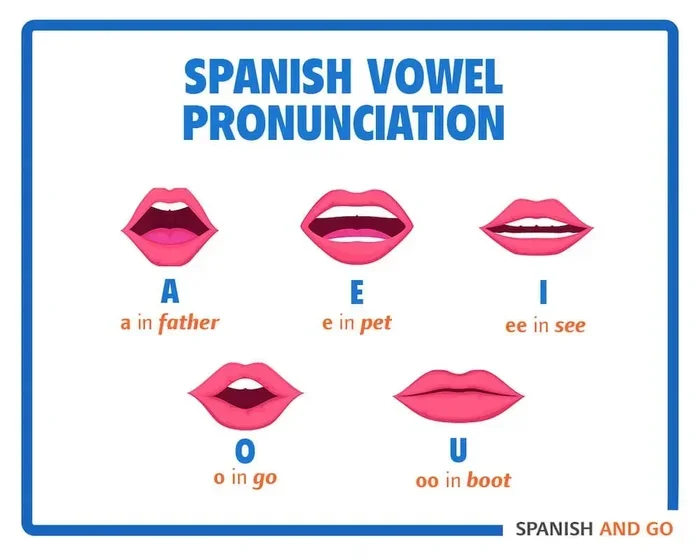
Spanish has five vowel letters: A, E, I, O, and U. Each one makes a single, clean sound. Let us walk through each one so you can hear the difference.
The A sound is open and relaxed. Your mouth is wide open, and your tongue sits flat at the bottom of your mouth. It sounds like the “a” in “father.” Say “casa” (house) and you will nail it.
The E sound is somewhere between the “e” in “bed” and “ay.” Your mouth is more open than in English. Try “mesa” (table) and feel how your lips stay relaxed but slightly more forward.
The I sound is pure and tight. Your mouth is small, almost like a smile, and the tongue sits high. Think of the “ee” in “see.” Say “vino” (wine) and keep that smile shape steady.
The O sound starts round and full. Your lips push forward slightly, like you are about to say “oh.” Say “sol” (sun) and notice how the sound stays pure from start to finish.
The U sound is the most rounded. Your lips form a small circle, and the tongue sits high in the back. Think of the “oo” in “moon.” Say “luna” (moon) and feel how your lips stay rounded throughout.
Common Mistakes English Speakers Make with Spanish Vowels
Even though Spanish vowels are simple, English speakers tend to slip into old habits. Here are the most common mistakes and how to fix them.
Adding Extra Sounds
English speakers love to add little extra sounds between vowels. For example, we might say “wa-ter” instead of just “wah-ter.” In Spanish, this does not happen. Each vowel stands on its own. When you say “pelo” (hair), it is two clean sounds: “peh-loh.” Not “puh-eh-loh.” Keep it crisp.
Stretching Vowels Too Long
In English, we often stretch vowels for emphasis. We say “seee” or “noooo.” Spanish does not work this way. Spanish vowels are short and clipped. They are quick and clean. Try saying “bueno” (good) with short, punchy vowels: “bweh-noh.” That is the rhythm you want.
Swapping Vowel Sounds
Sometimes English speakers swap one vowel for another because the letters look familiar. The Spanish “e” is not the same as the English “e.” The Spanish “o” is not the same as the English “o.” You need to rewire your ear and your mouth. Listen to native speakers and copy them exactly. Over time, your brain will adjust.
Ignoring Stress Patterns
While vowels themselves do not change sound, stress affects how they are heard. In Spanish, one syllable in every word gets emphasized. If you put stress on the wrong syllable, native speakers might not understand you. For example, “papá” (dad) and “papa” (potato) sound completely different because of which vowel gets the stress.
How to Practice Spanish Vowel Sounds Every Day
Reading about vowels is helpful, but practice is what makes the difference. Here are some tried-and-true methods to build your Spanish pronunciation skills.
Shadow Native Speakers
Find a video or audio clip of a native Spanish speaker. Listen to one sentence. Then repeat it immediately, copying their rhythm, speed, and vowel sounds as closely as possible. This technique, called shadowing, trains your mouth muscles to form Spanish sounds naturally.
Record Yourself
Use your phone to record yourself speaking Spanish. Listen back and compare your pronunciation to a native speaker. You will notice differences you never caught before. This might feel uncomfortable at first, but it is one of the fastest ways to improve.
Use Minimal Pairs
Minimal pairs are words that differ by just one sound. In Spanish, try contrasting “cito” (I summon) with “cito” (I cite). Wait, let us use better examples. Try “casa” (house) versus “caza” (hunt). The only difference is the vowel sound. Practicing these pairs sharpens your ear and your mouth control.
Sing Along to Spanish Music
Music is a fun and effective way to practice vowel sounds. Choose songs with clear, slow vocals. Sing along and focus on matching the vowel sounds exactly. Artists like Juanes, Shakira, or Rosalía offer great material for beginners. Plus, it does not feel like studying.
Name Your Pets in Spanish
Here is a fun way to practice. Pick a Spanish name for a pet and use it every day. If you love stuffed animals, try Spanish teddy bear names for plush toys, or explore Spanish rabbit names and Spanish cat names for real or imaginary pets. Saying these names out loud reinforces your vowel sounds in a playful way.
The Role of Vowels in Spanish Diphthongs
Once you master the five pure vowel sounds, the next step is understanding diphthongs. A diphthong happens when two vowel sounds blend together smoothly within one syllable. This is very common in Spanish and gives the language its musical quality.
There are two types of diphthongs in Spanish. Rising diphthongs start with a weak vowel and move to a strong vowel. The weak vowels are I and U. For example, in “aire” (air), the I and A blend together. In “loure” (no, let us use “luz” – light), the U and the silent vowel create a smooth transition.
Falling diphthongs start with a strong vowel and move to a weak vowel. Think of “mio” (mine) or “leer” (to read). The strong vowel A, E, or O leads, and the weak vowel I or U follows quickly.
The key to diphthongs is not to break them apart. Do not say “a-i-re” as three separate syllables. Say it as one smooth sound: “eye-reh.” Practice makes this feel natural over time.
Spanish Vowel Sounds vs English Vowel Sounds
Understanding the difference between Spanish and English vowels helps you stop unconsciously translating English sounds into Spanish. Here is a quick comparison.
| Feature | Spanish Vowels | English Vowels |
|---|---|---|
| Number of sounds | 5 pure sounds | 15 or more vowel sounds |
| Consistency | One sound per letter | Multiple sounds per letter |
| Vowel length | Short and even | Long and short distinctions |
| Diphthongs | Common and smooth | Less frequent |
| Silent vowels | None | Common in some patterns |
| Stress rules | Predictable patterns | Less predictable |
As you can see, Spanish vowels are much more straightforward. This is great news for learners. You do not need years of practice to get them right. A few weeks of focused work can dramatically improve your vowel pronunciation.
Quick Tips for Vowel Mastery
- Open your mouth wide for A. Keep it small and tight for I and U.
- Practice each vowel sound in isolation before combining them.
- Listen to Spanish podcasts and repeat every sentence out loud.
- Focus on keeping your vowels short and clean.
- Do not let English vowel habits creep into your Spanish speech.
- Use a mirror to check your mouth position while practicing.
- Be patient. Your mouth muscles need time to learn new positions.
How Vowel Pronunciation Affects Your Spanish Accent
Getting your vowels right is the single biggest factor in sounding like a native Spanish speaker. People who struggle with Spanish pronunciation usually have the same problem: they are using English vowel sounds instead of Spanish ones.
When you say “toma” (take/drink), do you say it with a flat English “o” or a round, pure Spanish “oh”? That one difference changes everything. Native speakers hear the distinction immediately, even if your grammar and vocabulary are perfect.
The good news is that fixing your vowels can happen quickly. Because there are only five sounds to learn, you can focus all your energy on getting them right. Practice the vowels daily for just ten minutes, and you will notice a big difference within a few weeks.
Remember that Spanish phonetics are designed to be simple and logical. The language rewards clear, consistent pronunciation. When you respect the pure vowel sounds, your speech becomes clearer and more confident.
Final Thoughts on Mastering Spanish Vowels
Learning how to say vowels in Spanish properly is the foundation of great pronunciation. The five pure vowel sounds are consistent, predictable, and logical. Once you internalize them, your Spanish will sound noticeably more natural and fluid.
Do not get discouraged if it feels strange at first. Your mouth is learning new positions and your ear is learning new sounds. This takes time and repetition. But every day you practice, you get closer to sounding like a native Spanish speaker.
Start with the basics. Master each vowel sound one at a time. Then move on to diphthongs and stress patterns. Before you know it, you will be speaking Spanish with clarity and confidence. The journey of a thousand miles begins with a single vowel sound.
So open your mouth, relax your tongue, and say “A, E, I, O, U” the Spanish way. You will be surprised how fast your pronunciation improves. Keep practicing, stay curious, and enjoy the beautiful sound of the Spanish language.
Frequently Asked Questions
How many vowel sounds are there in Spanish?
Spanish has exactly five vowel sounds, one for each vowel letter: A, E, I, O, and U. Each vowel always makes the same sound, no matter where it appears in a word. This simplicity is one of the biggest advantages of learning Spanish pronunciation.
Why are Spanish vowels easier than English vowels?
Spanish vowels are easier because each letter has only one sound. English vowels can make many different sounds depending on the word and spelling. In Spanish, you never have to guess how a vowel should sound, which makes reading and speaking much more predictable.
Can English speakers learn Spanish vowel sounds quickly?
Yes, most English speakers can learn the five Spanish vowel sounds within a few weeks of daily practice. The key is to listen carefully, repeat often, and avoid falling back into English vowel habits. Consistent practice builds the muscle memory you need for natural pronunciation.
What are the most common vowel mistakes in Spanish?
The most common mistakes include adding extra sounds between vowels, stretching vowels too long, and swapping English vowel sounds for Spanish ones. English speakers also tend to stress the wrong syllable in words. Focusing on short, clean vowel sounds helps fix these issues quickly.
Do Spanish diphthongs change vowel sounds?
Diphthongs blend two vowel sounds together smoothly, but each individual vowel sound stays the same. The sounds glide from one to the other without any break. The key is to keep both vowel sounds clear and not to separate them into different syllables.
How can I practice Spanish vowels every day?
You can practice by shadowing native speakers, recording yourself and comparing, singing along to Spanish songs, and using minimal pairs to sharpen your ear. Even just ten minutes of daily practice focused on vowel sounds leads to noticeable improvement over time.
=== CONCLUSION ===
Mastering how to say vowels in Spanish is the first and most important step toward speaking the language well. The five pure vowel sounds are simple, consistent, and logical. When you commit to learning them properly, your pronunciation improves fast and your confidence grows.
Remember to keep your vowels short, clean, and crisp. Avoid the English habits that trip up most learners. Practice daily, listen to native speakers, and enjoy the process. With steady effort, you will sound like a native Spanish speaker in no time.



