
The communism meaning goes far beyond simple political theory — it is a complete system of ideas about equality, ownership, and how society should organize itself. At its core, communism meaning explores a world where wealth and power are shared equally among all people. Understanding this ideology helps you make sense of modern politics, economics, and global history.
Have you ever heard someone mention communism and wondered what it really means? The communism meaning is not just a word from history class. It is a full-blown way of thinking about how people should live together, share resources, and run their governments. Whether you are a student, a curious reader, or someone who wants to understand today’s news better, knowing the communism meaning gives you a powerful lens.
In this guide, we will break down the communism meaning in plain language. We will look at where it came from, how it works, and why it still matters. You do not need a politics degree to follow along. We will keep things simple, clear, and interesting. Let us dive right in.
Key Takeaways
- Communism meaning centers on collective ownership and the elimination of private property.
- Karl Marx is the father of modern communist ideology and shaped its core principles.
- Socialism vs communism are related but distinct systems with key differences.
- Communist countries like the Soviet Union and China put these ideas into practice with mixed results.
- Understanding communism meaning helps you grasp today’s political debates and economic discussions.
- Class struggle and wealth distribution are central themes in communist theory.
- Communist ideology continues to influence political movements worldwide.
📑 Table of Contents
What Does Communism Meaning Really Mean?
At its simplest, the communism meaning points to a system where everything is shared. No private property. No rich owners. No poor workers. Instead, the community as a whole owns the land, factories, and resources. Everyone contributes based on their ability, and everyone gets what they need.
That is the basic communism meaning in a nutshell. But like most big ideas, the details are more complex. The communism meaning also includes a vision of a classless society. In a classless world, no one is born into wealth or poverty. Your background does not decide your future.
The communism meaning is rooted in the idea that workers deserve the full value of their labor. Under capitalism, bosses earn profits from the work of others. Communism aims to flip that script. The communism meaning says the people who actually do the work should control the results.
Many people confuse the communism meaning with socialism. While they share similarities, they are not the same thing. We will explore that difference later. For now, just know that the communism meaning represents the most extreme end of the equality spectrum. It imagines a world where the state eventually fades away entirely.
Where Did the Communism Meaning Come From?
The modern communism meaning traces back to two thinkers: Karl Marx and Friedrich Engels. In 1848, they published a document called the Communist Manifesto. This short but powerful book laid out the communism meaning for the world to see. It became one of the most influential political texts ever written.
Marx studied how factory workers were treated during the Industrial Revolution. He saw poverty, long hours, and unfair wages. From those observations, he developed Marxist theory. The communism meaning in his view was the natural next step for human society. He believed capitalism would eventually collapse under its own contradictions.
Marx described history as a series of class struggles. Slave owners versus slaves. Lords versus serfs. Capitalists versus workers. The communism meaning promises to end this cycle once and for all. When the workers take control, the struggle ends. That is the core of the communism meaning according to Marx.
Engels helped shape the communism meaning too. Together, the two men built a complete framework for communist ideology. Their ideas spread across Europe and eventually around the globe. Today, the communism meaning continues to evolve as new thinkers add their perspectives.
The Core Principles Behind Communism Meaning
Now that you know the basics, let us look at the key principles of the communism meaning. These ideas form the foundation of the entire system. Each one plays a vital role in how a communist society would work.
Collective Ownership of Resources
The first pillar of the communism meaning is collective ownership. This means no single person owns land, factories, or businesses. Instead, the community or the state holds these resources for everyone. The communism meaning says private ownership of productive property leads to inequality.
In practice, this could look like farms owned by the whole village. Factories run by the workers themselves. Natural resources managed for the common good. The communism meaning envisions a world where nobody hoards wealth while others go without.
Abolition of Social Classes
The communism meaning aims to destroy social classes completely. In a communist society, there are no rich and no poor. There is no upper class and no lower class. Everyone belongs to the same group — the working people.
This does not mean everyone becomes exactly the same. People still have different skills and interests. But the communism meaning says no one should be born into privilege. Your job, your income, and your opportunities should not depend on your family background.
Wealth Redistribution
Wealth distribution is a big part of the communism meaning. The idea is simple: take from those who have too much, give to those who have too little. Under the communism meaning, the government manages this process to ensure fairness.
In theory, this creates a society where everyone’s basic needs are met. Housing, food, healthcare, and education would be available to all. The communism meaning sees these as rights, not privileges. Nobody should struggle to survive in a truly communist world.
No State or Government
Here is a twist. The communism meaning actually imagines a world without government — eventually. In the early stages, a strong state is needed to manage the transition. But the ultimate communism meaning is a stateless society.
Once everyone is equal and resources are shared fairly, there is no need for a government to enforce rules. The communism meaning sees the state as a tool of class control. When classes disappear, the state fades away too. This is one of the most misunderstood parts of the communism meaning.
Planned Economy
Under the communism meaning, the economy is planned, not left to the free market. Central planners decide what to produce, how much, and who gets it. This is called a planned economy. The communism meaning rejects the idea that supply and demand should control everything.
The goal is to eliminate waste and ensure everyone has what they need. No shortages caused by greed. No surpluses that benefit only the wealthy. The communism meaning promises an economy that serves all people, not just a few.
Communism vs Socialism: What Is the Difference?
People often mix up the communism meaning with socialism. They are related, but they are not the same. Understanding the difference helps clarify the true communism meaning.
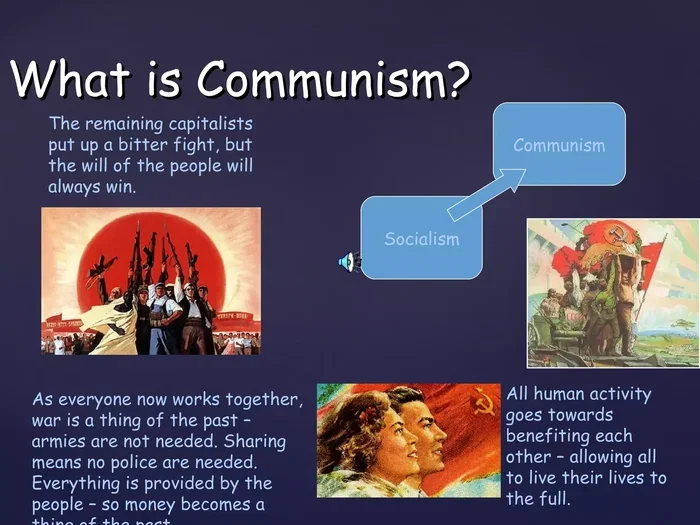
Socialism is like a stepping stone toward communism. In a socialist system, the government owns key industries and redistributes wealth. But private property can still exist. You might own your home and personal belongings. The communism meaning goes further. It eliminates private ownership of productive property entirely.
Here is a quick comparison table to make it clearer:
- Socialism: The government controls major industries but allows some private property.
- Communism: All property is collectively owned. No private ownership at all.
- Socialism: The state still exists to manage the economy.
- Communism: The state eventually disappears.
- Socialism: Rewards based on individual contribution.
- Communism: Rewards based on individual need.
The communism meaning is more radical than socialism. It seeks a complete transformation of society. Socialism tries to reform capitalism. Communism wants to replace it entirely. Both share the goal of greater equality, but they take different paths to get there.
Communism in Practice: Real-World Examples
The communism meaning sounds great on paper. But what happens when countries try to put it into practice? The history is complex and often painful. Let us look at some real-world examples.
The Soviet Union
The Soviet Union was the first major country to try building a communist society. After the 1917 revolution, the Bolsheviks established a government based on Marxist theory. They believed they were creating a real-world example of the communism meaning.
For a while, the Soviet model worked in some ways. Literacy rates rose. Factories were built. Healthcare expanded. But the communism meaning in practice also led to serious problems. The state grew incredibly powerful. Political freedoms were limited. Millions suffered under the system.
The Soviet example shows that the gap between the communism meaning and real-world communism can be huge. The theory promises freedom and equality. The practice sometimes delivered the opposite.
China Under Mao
China adopted communist ideology and beliefs in 1949 under Mao Zedong. Mao tried to fast-track the communism meaning through campaigns like the Great Leap Forward. These efforts aimed to rapidly transform China from an agrarian society into an industrial communist state.
The results were devastating. The Great Leap Forward led to one of the worst famines in human history. Millions died. The communism meaning in China took a brutal turn. The government used extreme force to maintain control.
Today, China is officially communist, but its economy has embraced many capitalist practices. This shows how the communism meaning evolves — or gets bent — when put into real-world practice.
Cuba and Other Communist Nations
Cuba became communist after Fidel Castro’s revolution in 1959. The communism meaning shaped Cuban society for decades. The government provides free healthcare and education. But political freedoms are restricted, and economic challenges persist.
Other communist countries include Vietnam, Laos, and North Korea. Each has interpreted the communism meaning differently. North Korea, for example, developed its own version called Juche. This shows that the communism meaning is not a one-size-fits-all system.
Why Understanding Communism Meaning Matters Today
You might wonder why learning about the communism meaning matters in the 21st century. After all, the Soviet Union collapsed in 1991. Does it still matter?
Absolutely. The communism meaning continues to shape global politics. Countries like China and Cuba still operate under communist systems. The communism meaning influences debates about wealth inequality, healthcare, and workers’ rights everywhere.
When politicians talk about free healthcare or public education, they are often echoing ideas from the communism meaning. When people protest against billionaires and corporate greed, they are tapping into the same spirit. Understanding the communism meaning helps you see these connections.
The communism meaning also helps you think critically about the world. It gives you a framework for asking big questions. Who owns the wealth? Who benefits from the current system? What would a truly equal society look like? These are questions the communism meaning asks us to confront.
Even if you disagree with the communism meaning, understanding it makes you a more informed citizen. It helps you engage in meaningful discussions. It helps you spot misinformation. And it helps you appreciate the complexity of global politics.
Quick Tips for Understanding Communism Meaning
- Start with the basics: Read the Communist Manifesto or a simple summary of Marxist theory.
- Separate theory from practice: The communism meaning as an idea is different from how it was implemented.
- Compare systems: Look at capitalism, socialism, and communism side by side to see the differences.
- Stay curious: The communism meaning is a living concept that continues to evolve.
- Ask questions: Always ask who benefits and who loses when systems change.
Common Mistakes People Make About Communism Meaning
Many people misunderstand the communism meaning. Here are some common mistakes to avoid.
- Confusing communism with socialism: They are related but distinct. The communism meaning goes much further than socialism.
- Assuming all communist countries are the same: Each country interprets the communism meaning differently.
- Thinking communism means no personal property: The communism meaning targets productive property, not personal belongings.
- Ignoring the theory: The communism meaning as an ideal has merit. The failures in practice do not erase the original ideas.
- Dismissing it as irrelevant: The communism meaning still shapes politics in China, Cuba, and beyond.
Expert Insights on Communism Meaning
Political scholars often point out that the communism meaning is one of the most misunderstood ideologies in the world. Dr. Richard Wolff, an economist, notes that many people judge the communism meaning only by its worst historical examples. He argues that the core ideas — equality, shared resources, and worker dignity — still hold value today.
Professor Noam Chomsky has also discussed the communism meaning in modern contexts. He points out that many of the goals of the communism meaning — universal healthcare, free education, and economic equality — are already achieved in many democratic countries. The communism meaning pushed humanity to aim higher, even if the execution fell short.
These experts remind us that the communism meaning is not just about the past. It is a living tradition of thought that continues to inspire movements for justice and equality around the world.
The Legacy of Communism Meaning in Modern Society
The communism meaning has left an indelible mark on the modern world. Its influence extends far beyond the borders of former communist countries. The communism meaning shaped labor movements, inspired civil rights campaigns, and influenced economic policies across the globe.
Many of the worker protections we enjoy today exist because of the pressure created by communist ideology. The eight-hour workday, minimum wage laws, and workplace safety regulations all gained momentum partly because of the communism meaning and the movements it inspired.
Even in countries that rejected communism, the communism meaning forced governments to address inequality. The threat of communist revolution pushed capitalist nations to reform. They created social safety nets, public services, and labor protections they might not have otherwise offered.
Today, the communism meaning continues to spark debate. As wealth inequality grows and workers face new challenges, the ideas behind the communism meaning feel relevant again. Younger generations are rediscovering Marxist theory and finding new ways to apply its insights.
The communism meaning also challenges us to think about what kind of world we want to build. It asks us to imagine a society where everyone has enough. Where no one is left behind. Where the fruits of our labor benefit everyone equally. These are powerful questions that the communism meaning puts on the table.
Whether you embrace the communism meaning fully, reject it entirely, or find a middle ground, understanding it is essential. It is one of the most significant forces that shaped the modern world. And its ideas continue to influence politics, economics, and culture in profound ways.
Conclusion
The communism meaning is a rich and complex topic that deserves thoughtful exploration. From its roots in the ideas of Karl Marx to its real-world implementations in countries like the Soviet Union and China, the communism meaning has shaped human history in profound ways. It represents a bold vision of equality, shared ownership, and a classless society.
We have covered a lot of ground in this guide. You now understand the core principles of the communism meaning. You know how it differs from socialism. You have seen how it played out in real countries. And you understand why it still matters today.
The communism meaning is not just a historical concept. It is a living idea that continues to challenge us to build a fairer world. Whether you agree with it or not, engaging with its ideas makes you a stronger thinker and a more informed citizen. Keep exploring, keep questioning, and never stop learning about the forces that shape our world.
Frequently Asked Questions
What is the simple communism meaning?
The communism meaning in simple terms is a system where all property and resources are owned collectively by the community. There is no private ownership, no social classes, and everyone shares wealth equally. The communism meaning aims to create a society where every person’s needs are met without exploitation.
Who created the communism meaning?
The modern communism meaning was developed by Karl Marx and Friedrich Engels in the mid-1800s. Their most famous work, the Communist Manifesto, laid out the core ideas of communist ideology. Marx’s Marxist theory remains the foundation of how we understand the communism meaning today.
How is socialism different from communism?
The communism meaning is more radical than socialism. Socialism allows for some private property and uses government to redistribute wealth. The communism meaning eliminates private ownership of productive property entirely and eventually aims for a stateless society. Socialism is often seen as a stepping stone toward communism.
Are there communist countries today?
Yes, several countries still operate under communist systems. China, Cuba, Vietnam, Laos, and North Korea are the main communist countries today. However, many of these nations have mixed their interpretation of the communism meaning with capitalist economic practices.
What is class struggle in the communism meaning?
Class struggle is a central concept in the communism meaning. It refers to the conflict between different social classes, especially between the working class and the ruling class. Marx believed that this struggle drives historical change and that communism would end it by eliminating class divisions entirely.
Why did communism fail in some countries?
The communism meaning as an ideal faced many challenges in practice. Authoritarian leaders often twisted the communism meaning to justify total control. Economic inefficiencies, lack of individual freedoms, and corruption undermined many communist experiments. The gap between the theory of the communism meaning and its real-world execution proved very difficult to bridge.