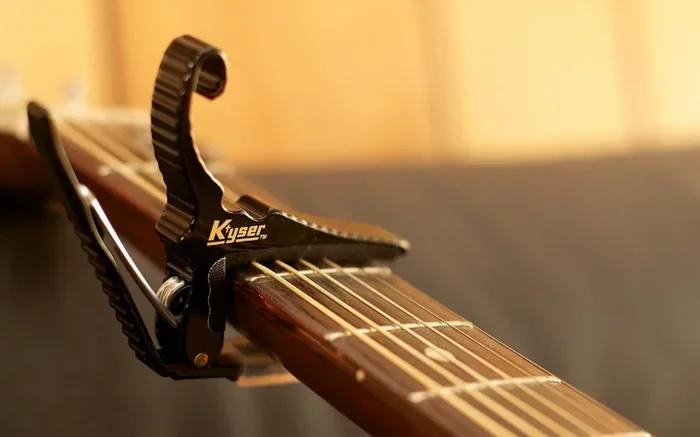

The capo meaning is simple: it is a small clamp that shortens your guitar strings and raises the pitch. Understanding the capo meaning unlocks new ways to play songs, change keys, and sing along more comfortably. Whether you are a beginner or a seasoned player, knowing what a capo does will transform your guitar experience.
If you have ever watched a guitar player slap a small clamp on the neck of their guitar mid-song and wondered what that thing was, you are not alone. That little device is called a capo. And understanding the capo meaning is one of the simplest ways to level up your guitar game.
The capo meaning might sound technical, but it really is not. A capo is a clamp that presses down all six strings at once on a specific fret. It works like a movable nut. This changes the pitch of every open string and effectively moves the key of the song up or down. For many players, a capo on guitar is an essential tool that opens up a world of musical possibilities.
In this guide, we will break down the capo meaning in plain language. We will cover how it works, why players use it, and how to place it correctly. By the end, you will know exactly why guitar players of all levels need one.
Key Takeaways
- Capo meaning: A capo is a clamp that presses all strings against a fret, effectively moving the nut higher up the neck.
- Key change made easy: Using a capo lets you shift the song key without learning new chord shapes.
- Open chords stay open: A capo lets you keep using simple open chord shapes while playing in different keys.
- Capo placement matters: Placing the capo correctly avoids buzzing and ensures clean sound.
- Capo vs barre chord: Both raise the pitch, but a capo is easier and faster to use.
- Singing becomes easier: Many singers use a capo to match their vocal range.
- Choose the right capo: Different guitar types need different capo styles for the best hold and pressure.
📑 Table of Contents
What Does Capo Mean?
The word capo comes from the Italian term “capotasto.” That literally means “head of the fretboard.” So when you look up the capo meaning, you are really just learning what that head clamp does. It clamps onto the neck and acts as a new nut for the guitar.
Here is the simplest way to think about it. When you play a guitar without a capo, the open strings ring out at their standard tuning. That is E, A, D, G, B, and E from low to high. When you place a capo on the second fret, you are telling the guitar that the second fret is now your new open position. Every chord shape you play shifts up by two half steps.
Many beginner guitar players ask, “what does capo do?” The answer is straightforward. It raises the pitch of all strings evenly. This lets you play the same chord shapes you already know but in a different key. That is the core capo meaning in action.
The Italian Origin and Musical History
The capo has been around for centuries. Early musicians used it to match their instruments to different vocal ranges. Before capos were widely available, players used their fingers or even strips of cloth to shorten string length. Today, the capo meaning stays the same, but the tools have become much more refined and precise.
In folk, country, and pop music, the capo is everywhere. Artists like Jimi Hendrix, Joni Mitchell, and Ed Sheeran have all used one. If these players rely on a capo on guitar, there is a good chance you will find it useful too.
How Does a Capo Work?
Now that you know the capo meaning, let us talk about how it actually works. The device clamps down across all six strings at a chosen fret. This pressure stops the strings from vibrating past that point. In simple terms, it shortens the vibrating length of each string.
When you shorten the vibrating length, the pitch goes up. The higher the fret you place the capo on, the higher the pitch becomes. For example, placing a capo on the first fret raises every open string by one half step. Placing it on the fifth fret raises them by five half steps.
Understanding Capo Positions
Each fret number on the guitar represents a half step. Here is a quick look at how capo positions change your key:
- Capo on fret 1: Raises pitch by one half step. Key of C becomes key of C sharp.
- Capo on fret 3: Raises pitch by three half steps. Key of G becomes key of A flat.
- Capo on fret 5: Raises pitch by five half steps. Key of E becomes key of A.
- Capo on fret 7: Raises pitch by seven half steps. Key of D becomes key of E.
- Capo on fret 12: Raises pitch by one full octave. Key of A becomes key of A again, just higher.
These capo positions are easy to remember once you understand the half-step system. You do not need to be a music theory expert. Just knowing which fret you are on gives you a clear picture of where your pitch lands.
The Capo and the Fretboard
The fretboard is the long strip of wood with metal strips running across it. Those metal strips are called frets. When you press a string behind a fret, you shorten its length and raise its pitch. A capo does the same thing, but it does it for all strings at once. This is the core capo meaning in the simplest terms possible.
Why Guitar Players Need a Capo
The capo meaning becomes much clearer once you see why so many players use one. A capo solves real problems that guitar players face every day. Let us look at the main reasons a capo is so helpful.
Changing Keys Without Learning New Chords
This is the biggest reason players reach for a capo. Say you know how to play a song in the key of G using open chords like G, C, and D. But the singer finds that key too low for their voice. Instead of learning new chord shapes, you just slap a capo on the second fret and play the same G, C, and D shapes. The song now sounds in the key of A. Your chord shapes did not change at all. The capo meaning did all the heavy lifting.
This is a game changer for acoustic guitar capo players. Many popular songs use different keys for different singers. With a capo, you can play the same easy shapes and just move the clamp up or down the neck.
Making Singing Easier
If you play guitar and sing at the same time, you know how tricky matching your voice to a chord can be. Some keys feel comfortable for your voice. Others feel strained. A capo lets you find the sweet spot fast. You keep your familiar open chord shapes and just shift the key until it feels right for your voice.
This is especially common in singer-songwriter music. Players often use a capo for singing to match their natural vocal range. It keeps the performance feeling natural and effortless.
Brightening Your Tone
A capo does more than change the key. It also changes the tone of the guitar. When you play higher up the neck, the sound gets brighter and more resonant. Many players love the capo tone for acoustic songs. It adds a crisp, shimmering quality that open chords lower on the neck sometimes lack.
Think of it this way. A capo on the first fret gives you a slightly warmer, softer sound. A capo on the seventh fret gives you a bright, ringing tone that cuts through a mix. The capo meaning includes this tonal shift, and it is one reason players reach for one even when the key is already comfortable.
Simplifying Complex Chord Shapes
Some songs use chord shapes that are hard to play. Barre chords can be tough for beginners. But with a capo, you can often replace those difficult shapes with simple open chords. For example, a song that calls for a barre chord on the eighth fret might be played with a simple open G shape and a capo on the fifth fret.
This makes the capo meaning a real problem solver. It opens up songs that might otherwise feel too hard to play.
Playing With Other Musicians
If you play in a band or jam with friends, matching keys is essential. A capo lets you quickly adjust your key to fit the singer or another instrument. Without one, you might need to learn multiple versions of the same song in different keys. The capo saves you all that time and effort.
How to Place a Capo Correctly
Knowing the capo meaning is only half the battle. You also need to know how to place it properly. A poorly placed capo can cause buzzing, tuning issues, and frustration. Here is how to do it right.
Step-by-Step Capo Placement
- Find the right fret: Decide which fret you need based on the key you want to play in. Use a capo chart if you are unsure.
- Position the capo just behind the fret: Place it right behind the metal fret wire, not in the middle of the fret space.
- Press down firmly: Make sure the capo applies even pressure across all six strings.
- Check each string: Strum every string one by one. Listen for buzzing or muted notes. Adjust the capo if needed.
- Tune after placing the capo: Capos can pull strings slightly sharp. Always do a quick tune check.
Common Capo Mistakes to Avoid
Even experienced players make mistakes with capo placement. Here are the most common ones:
- Placing the capo too far from the fret: This causes buzzing and dead notes. Always keep it close to the fret wire.
- Using too much pressure: A heavy capo can bend strings out of tune. Use just enough pressure to hold the strings down cleanly.
- Forgetting to retune: Capos affect string tension. Always retune after clipping it on.
- Using a cheap capo that slips: A poor-quality capo loses pressure mid-song. Invest in a reliable one.
- Not accounting for string gauge: Thicker strings need more clamping force. Make sure your capo fits your guitar type.
Quick Tips for Capo Placement
- Always place the capo right behind the fret, not on top of it.
- Strum all six strings after clipping to check for clear sound.
- Use a capo chart to find the right fret for any key change.
- Remove the capo when you are not playing to save string tension.
- Practice placing the capo quickly so it becomes second nature.
Capo vs Barre Chord
Many beginner players wonder about the difference between using a capo and playing a barre chord. Both raise the pitch of the strings, but they work in different ways. Understanding this comparison helps clarify the full capo meaning.
A barre chord uses your index finger to press down all six strings across one fret. You then shape a chord with your other fingers above the barre. This is a powerful technique, but it takes serious finger strength and practice. A capo does the same job without any finger effort. It clamps down all strings for you.
Key Differences at a Glance
| Feature | Capo | Barre Chord |
|---|---|---|
| Ease of use | Very easy | Difficult for beginners |
| Finger strength needed | None | High |
| Speed of key change | Instant | Requires learning new shapes |
| Tone flexibility | Bright and open | Versatile across the neck |
| Practical use | Key matching, singing | Full chord vocabulary |
| Best for | Open chord players | Advanced players |
The capo meaning and the barre chord meaning overlap in some ways. Both shift the pitch up the fretboard. But they serve different purposes. A capo keeps your playing simple and fast. A barre chord gives you full access to every chord shape on the neck. Many players use both together.
Best Capos for Different Guitar Types
Not all capos are the same. Different guitars need different capo styles to get the best results. Understanding this part of the capo meaning helps you choose the right tool for your instrument.
Capos for Acoustic Guitars
Acoustic guitars have thicker strings and higher action. You need a capo that applies strong, even pressure. A spring-loaded capo works well for most acoustic players. It clamps on quickly and holds firmly. Look for capos with rubber padding to protect the guitar neck.
Capos for Electric Guitars
Electric guitars have thinner strings and lower action. A lighter capo works best here. You do not need as much clamping force. A toggle capo or a lightweight spring capo is ideal. These capos are easy to attach and remove quickly during performances.
Capos for Classical Guitars
Classical guitars have nylon strings and a wider neck. Standard capos may not fit well. Look for a capo designed specifically for classical guitars. These capos have wider pads and gentle pressure to protect the delicate nylon strings.
Quick Tips for Choosing a Capo
- Match the capo to your guitar type for the best fit.
- Choose a capo with adjustable tension for more control.
- Look for rubber or silicone padding to prevent neck damage.
- Pick a capo that is easy to attach and remove quickly.
- Read reviews before buying to find a reliable brand.
Capo Meaning in Real-World Song Examples
The capo meaning comes alive when you see it in action. Many famous songs use a capo to achieve their signature sound. Here are a few examples.
In “Here Comes the Sun” by The Beatles, George Harrison used a capo on the seventh fret. This brightened the tone and made the open chord shapes ring beautifully. The song sounds warm and uplifting partly because of that capo placement.
Ed Sheeran is known for using a capo on almost every song he plays live. In “Thinking Out Loud,” he uses a capo on the first fret. This lets him sing comfortably while playing simple open chords. The capo makes the song feel natural and effortless.
Bob Dylan frequently used a capo in his folk songs. In “Blowin in the Wind,” a capo on the second fret allows the player to use basic open chords while matching the original key. The capo meaning here is clear: it keeps the song accessible while preserving the right pitch.
These examples show that the capo is not just a beginner tool. Professional players at the highest level rely on it every day. Understanding the capo meaning connects you to a long tradition of great music.
Practical Capo Exercises for Beginners
If you are new to the capo, try these simple exercises. They will help you get comfortable with the device and understand its full capo meaning.
Exercise 1: Key Change Practice
Start by playing a simple chord progression in the key of G. Play G, C, and D. Then place a capo on the second fret. Now play the same G, C, and D shapes. Listen to how the key has shifted to A. This is one of the clearest ways to feel the capo meaning in your hands.
Exercise 2: Capo Chart Exploration
Print out or download a capo chart. Use it to find out which fret you need for different key changes. Practice moving the capo to each position and playing a simple open chord shape. Notice how the sound changes with every fret.
Exercise 3: Sing and Play with a Capo
Pick a song you know well. Sing along while playing it in the original key. Then try the same song with a capo placed at different frets. Find the position where your voice feels most comfortable. This exercise shows you the capo meaning from a singer-songwriters perspective.
Exercise 4: Tone Comparison
Play an open G chord without a capo. Listen to the warm, deep tone. Now place a capo on the fifth fret and play the same G chord shape. Listen to the bright, ringing tone. This simple comparison helps you understand how the capo changes not just the key but also the feel of the sound.
Key Takeaways
- Capo meaning: A capo is a clamp that presses all strings against a fret, acting as a movable nut to raise pitch.
- Key change made easy: Using a capo lets you shift the song key without learning new chord shapes.
- Open chords stay open: A capo lets you keep using simple open chord shapes while playing in different keys.
- Capo placement matters: Placing the capo correctly behind the fret avoids buzzing and ensures clean sound.
- Capo vs barre chord: Both raise pitch, but a capo is faster and easier for key changes.
- Singing becomes easier: Many singers use a capo to match their vocal range comfortably.
- Choose the right capo: Different guitar types need different capo styles for the best hold and pressure.
Frequently Asked Questions
What is the capo meaning in simple terms?
A capo is a small clamp that you attach to the guitar neck. It presses down all the strings at a chosen fret, acting like a movable nut. This raises the pitch of every open string and changes the key of the song. That is the basic capo meaning in the simplest words possible.
Why do guitar players use a capo?
Players use a capo to change the key of a song without learning new chord shapes. It also makes singing easier by matching the vocal range. Many players love the brighter tone a capo adds to acoustic songs. The capo meaning covers all of these practical benefits.
Is a capo the same as a barre chord?
Not exactly. Both raise the pitch, but a barre chord uses your finger to press all strings down. A capo clamps them for you. A capo is faster and easier, especially for beginners. A barre chord gives you more flexibility across the entire fretboard. Understanding the capo meaning helps you see how both tools fit into your playing.
Where should I place the capo on the fretboard?
Always place the capo right behind the metal fret wire, not in the middle of the fret space. This ensures clean sound and prevents buzzing. Use a capo chart to find the right fret for your desired key. Proper placement is a key part of the full capo meaning.
Can a capo damage my guitar?
A good capo will not damage your guitar if used correctly. However, a capo that is too tight or left on for long periods can leave marks on the neck. Always remove the capo when you are done playing. Choose a capo with rubber padding to protect the fretboard. This is an important detail in understanding the capo meaning responsibly.
What type of capo is best for beginners?
A spring-loaded capo is the best choice for beginners. It is easy to attach and remove with one hand. It applies consistent pressure across all strings. Look for a capo with adjustable tension and soft rubber padding. This makes the capo meaning experience simple and frustration-free for new players.
=== CONCLUSION ===
The capo meaning is one of the most useful concepts in guitar playing. It is simple, practical, and powerful. A capo lets you change keys, sing more comfortably, and brighten your tone with just one small clamp. Whether you are playing acoustic or electric, the capo meaning stays the same: it moves the nut up the neck and raises the pitch of every string.
Guitar players at every level benefit from using a capo. Beginners use it to keep things simple. Singer-songwriters use it to match their voice. Professional musicians use it to match keys with other players. The capo meaning connects all of these uses into one easy-to-understand tool.
Now that you understand the capo meaning, it is time to try one for yourself. Pick up a capo, clip it on a fret, and play your favorite open chords. Listen to how the sound shifts. Notice how the key changes without learning a single new shape. Once you feel the difference, you will wonder how you ever played without one. A capo is not just a gadget. It is a gateway to more music, more songs, and more joy on the guitar.