
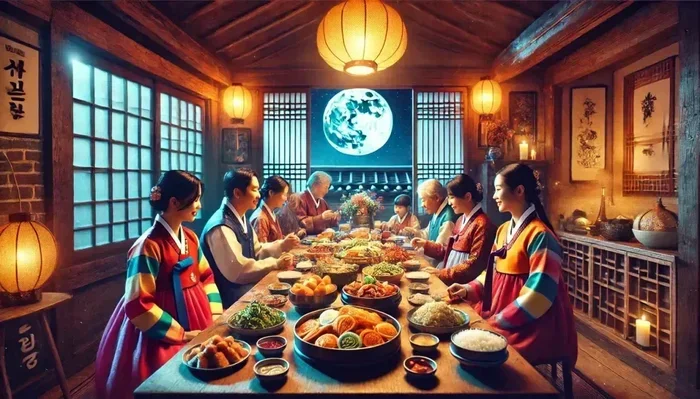

To say happy Chuseok in Korean, you use the phrase “Chuseok jal jinaeusseumnida” (추석 잘 지냈습니다). This greeting is the standard and most respectful way to wish someone well during Korea’s most important harvest festival. Chuseok is often called Korean Thanksgiving and is a time for family, food, and honoring ancestors. Knowing the right phrase and understanding the traditions behind it helps you connect with Korean culture on a deeper level.
Have you ever wanted to impress your Korean friends during one of the biggest holidays of the year? Maybe you have Korean coworkers, a Korean partner, or you simply love learning about other cultures. Whatever your reason, knowing how to say happy Chuseok in Korean opens a door to a richer, more meaningful connection.
Chuseok is Korea’s version of Thanksgiving. It falls on the 15th day of the eighth lunar month. Families gather, food is shared, and ancestors are honored. It is one of the most important holidays in Korean culture. And just like any big celebration, there is a special way to greet people during this time.
In this guide, you will learn the exact phrase to say, how to pronounce it, what it means, and much more. We will also walk you through the traditions that make Chuseok so special. By the end, you will feel confident using the greeting and understanding the celebration behind it.
Key Takeaways
- Standard Greeting: “Chuseok jal jinaeusseumnida” is the most common and respectful way to say happy Chuseok in Korean.
- Casual Alternative: “Chuseok jal jinaessseubnida” works for slightly less formal settings.
- Cultural Depth: Chuseok is more than a greeting — it is a major Korean holiday centered on family, food, and ancestor respect.
- Key Traditions: Charye (ancestral rites), songpyeon making, and seongmyo (grave visits) are core Chuseok activities.
- Pronunciation Matters: Breaking the phrase into smaller parts makes it much easier to say correctly.
- Internal Link: Understanding phrases like “in situ” helps you appreciate how Korean traditions are preserved in their original cultural context.
📑 Table of Contents
- How to Say Happy Chuseok in Korean
- What Is Chuseok and Why Does It Matter?
- Key Chuseok Traditions You Should Know
- Common Chuseok Foods to Try
- How to Wish Someone Happy Chuseok in Different Situations
- Quick Tips for Celebrating Chuseok Respectfully
- Common Mistakes to Avoid
- Expert Insights on Chuseok Greetings
- Key Takeaways
- Conclusion
How to Say Happy Chuseok in Korean
The standard way to say happy Chuseok in Korean is “Chuseok jal jinaeusseumnida” (추석 잘 지냈습니다). Let us break that down so it feels less intimidating.
- Chuseok (추석) — This is the name of the holiday itself. It refers to the Korean autumn harvest festival.
- Jal (잘) — This means “well” or “good.” It adds a positive wish to the phrase.
- Jinaeusseumnida (지냈습니다) — This means “have you spent” or “did you spend.” It is a polite way of asking how someone’s holiday was.
When you put it all together, the phrase translates roughly to “Did you spend Chuseok well?” It is a warm, respectful greeting that Korean people truly appreciate when foreigners use it.
Pronunciation Tips
Pronouncing Korean phrases can feel tricky at first, but this one is quite manageable. Here is a simple breakdown:
- Chuseok — Say “choo-suhk.” The “ch” is soft, like the “ch” in “cheese” but lighter.
- Jal — Say “jahl.” It rhymes roughly with “pal.”
- Jinaeusseumnida — Say “ji-nay-sseu-mnida.” Break it into chunks: “ji-nay” + “sseu” + “mnida.”
Do not worry about sounding perfect. Korean people are generally very kind and appreciative when someone tries to speak their language. The effort alone means a lot.
Casual and Formal Variations
Korean has different levels of politeness, and Chuseok greetings are no exception. Here are a few variations you can use depending on the situation.
Formal (존댓말): “Chuseok jal jinaeusseumnida” (추석 잘 지냈습니다). Use this with elders, strangers, or in professional settings.
Standard (해요체): “Chuseok jal jinaessseubnida” (추석 잘 지냈어요). This is friendly and works well with peers or people you are not close to yet.
Casual (반말): “Chuseok jal jinaessseo?” (추석 잘 지냈어?). Use this only with close friends or people younger than you.
When in doubt, go with the formal version. It shows respect, and Koreans value politeness highly, especially during holidays.
What Is Chuseok and Why Does It Matter?
Understanding the holiday behind the greeting makes the phrase even more meaningful. Chuseok is not just a single-day event. It is a multi-day celebration that centers on family, gratitude, and tradition.
Often called Korean Thanksgiving, Chuseok shares the same spirit as its American counterpart — giving thanks for a bountiful harvest. But it goes much deeper in Korean culture. It is a time to honor ancestors, strengthen family bonds, and share food.
The holiday dates back thousands of years. Its roots are tied to agricultural life and the lunar calendar. Even today, millions of Koreans travel across the country to be with their families during Chuseok. This mass movement is called Chuseok seolchul (추석 성묶), and it is one of the busiest travel periods in South Korea.
Many Korean traditions are kept in situ, meaning they are practiced in their original cultural setting and passed down through generations. This preservation of tradition is a big part of what makes Chuseok so special.
The Lunar Calendar Connection
Chuseok follows the lunar calendar, which means the date changes every year on the Gregorian calendar. In 2024, Chuseok falls on September 17. In 2025, it will be on October 6. The holiday always lands on the full moon of the eighth lunar month, which is significant in Korean culture.
The full moon symbolizes completeness and abundance. This ties perfectly into the harvest theme of Chuseok. Families gather under the full moon, share meals, and give thanks together.
Key Chuseok Traditions You Should Know
Greeting someone with “Chuseok jal jinaeusseumnida” is a great start, but knowing the traditions behind the holiday takes your understanding to the next level. Here are the most important customs.
Charye (차례) — Ancestral Rites
Charye is the most important Chuseok tradition. It is a ceremony where families pay respect to their ancestors. This usually happens early in the morning of Chuseok day.
During charye, families prepare a special table full of food offerings. The table is arranged in a specific order. Each dish has a meaning. For example, fish is placed on the east side, and meat is placed on the west side. The eldest male family member typically leads the ceremony.
Family members bow deeply to the ancestral table. This is a solemn and beautiful moment that connects generations. It is one of the most moving parts of the entire Chuseok celebration.
Songpyeon (송편) — Traditional Rice Cakes
No Chuseok is complete without songpyeon. These are small, half-moon-shaped rice cakes made from freshly harvested rice flour.
Songpyeon is steamed over a layer of pine needles. This gives the cakes a subtle, fragrant pine flavor. Families often gather together to make songpyeon the day before Chuseok. It is a fun, hands-on activity that brings everyone closer.
Each family has its own recipe. Some fill songpyeon with sweet sesame seeds, others with red bean paste, and some with chestnuts. The shape of the half moon is also symbolic. It represents fullness and prosperity.
Seongmyo (성묶) — Visiting Ancestral Graves
Another key tradition is seongmyo, which means visiting and cleaning ancestral graves. Families travel to the burial sites of their ancestors, often early in the morning.
They clear away weeds, tidy up the area, and leave food offerings. This act of remembrance shows deep respect for family history. It is a quiet, reflective tradition that contrasts with the festive meals that follow.
Ganggangsullae (강강술래) — Circle Dance
In some regions of Korea, especially in the south, women gather to perform ganggangsullae. This is a traditional circle dance done under the full moon.
Women hold hands, form a large circle, and sing and dance together. The dance has its roots in folklore and has been passed down for centuries. It is joyful, energetic, and deeply connected to the harvest celebration.
Common Chuseok Foods to Try
Food is at the heart of Chuseok. The holiday table is filled with dishes that celebrate the autumn harvest. Here are some of the most iconic foods you will find during Chuseok.
- Songpyeon — The iconic half-moon rice cakes we mentioned above.
- Japchae (잡채) — Glass noodles stir-fried with vegetables and beef. It is colorful, delicious, and a staple at Korean celebrations.
- Jeon (전) — Savory pancakes made with seafood, vegetables, or meat. They are crispy on the outside and tender inside.
- Galbi (갈비) — Marinated short ribs that are grilled to perfection. A Chuseok table is not complete without them.
- Baekju (백주) — Traditional rice wine that is often shared during the holiday.
Preparing these dishes takes time and effort. Many families start cooking the day before Chuseok. The kitchen becomes the heart of the home during this period.
How to Wish Someone Happy Chuseok in Different Situations
Now that you know the phrase, let us look at how to use it in real-life situations. Context matters a lot in Korean culture.
In Person
If you are speaking to a Korean friend or colleague in person, a simple “Chuseok jal jinaeusseumnida” followed by a slight bow of the head goes a long way. Koreans appreciate the effort of using the language, and it shows cultural awareness.
In a Text or Message
Sending a text message during Chuseok is very common. You can write “추석 잘 지냈습니다” or simply “Happy Chuseok!” Many Koreans also send Chuseok greeting cards, especially through messaging apps like KakaoTalk.
On Social Media
If you are posting on social media, you can write “Wishing everyone a happy Chuseok! 🌕” The full moon emoji is a perfect touch since Chuseok is tied to the full moon.
Quick Tips for Celebrating Chuseok Respectfully
If you are invited to a Chuseok celebration or want to observe the holiday respectfully, keep these tips in mind.
- Dress modestly. Avoid flashy or overly casual clothing, especially if attending a charye ceremony.
- Let the eldest lead. During meals and ceremonies, older family members go first. Follow their lead.
- Try everything. Food offerings at the ancestral table are often shared among family afterward. Be open to trying new dishes.
- Bring a small gift. If you are visiting a Korean friend’s home, bringing fruit or a small gift is a thoughtful gesture.
- Be patient. Chuseok gatherings can be long and busy. Enjoy the pace and soak in the atmosphere.
Common Mistakes to Avoid
Even with the best intentions, it is easy to make small mistakes when participating in a cultural celebration that is not your own. Here are a few to watch out for.
- Using casual language with elders. Always default to the formal version of the greeting unless you are sure it is okay to be casual.
- Touching ancestral food. The food on the charye table is sacred. Do not touch or eat it unless invited.
- Ignoring the meaning behind the traditions. Chuseok is about gratitude and remembrance. Treat it with the respect it deserves.
- Confusing Chuseok with Seollal. Seollal is the Korean Lunar New Year. Both are major holidays, but they have different traditions and greetings.
Expert Insights on Chuseok Greetings
According to Korean language experts, the way you greet someone during Chuseok reflects your understanding of Korean values. Respect for elders, family unity, and gratitude are at the core of the holiday. Using the right phrase in the right tone shows that you are not just learning words — you are embracing a culture.
Many Korean teachers recommend practicing the phrase out loud several times before using it. Pronunciation may feel awkward at first, but with a little practice, it becomes natural. The key is sincerity. When you say “Chuseok jal jinaeusseumnida” with genuine warmth, people will notice and appreciate it.
Key Takeaways
- The standard greeting is “Chuseok jal jinaeusseumnida,” which is polite and widely used across all age groups.
- Break the phrase into parts — Chuseok, jal, jinaeusseumnida — to make pronunciation easier.
- Chuseok is a multi-day harvest festival centered on family, food, and honoring ancestors.
- Key traditions include charye, songpyeon making, seongmyo, and ganggangsullae.
- Use formal language with elders and casual language only with close friends.
- Respect the cultural significance of the food and rituals associated with the holiday.
Conclusion
Learning how to say happy Chuseok in Korean is more than just memorizing a phrase. It is a small but meaningful way to honor Korean culture and connect with the people around you. The phrase “Chuseok jal jinaeusseumnida” carries warmth, respect, and good wishes — everything this beautiful holiday represents.
Whether you are texting a Korean friend, greeting a colleague, or simply expanding your cultural knowledge, this greeting is a great place to start. Pair it with an understanding of the traditions behind it, and you will have a connection to Chuseok that goes far beyond words.
So the next time Chuseok rolls around, you will know exactly what to say and why it matters. Give it a try. You might just make someone’s day.
Frequently Asked Questions
What does “Chuseok jal jinaeusseumnida” mean?
It translates roughly to “Did you spend Chuseok well?” It is a polite and respectful way to wish someone a good Chuseok holiday. The phrase combines the holiday name, the word for “well,” and a polite verb form.
Is there a simpler way to say happy Chuseok in Korean?
Yes. You can simply say “Happy Chuseok!” in English, and most Koreans will understand. For a Korean phrase, “Chuseok jal jinaessseubnida” is a slightly less formal option that still sounds warm and friendly.
When is Chuseok celebrated?
Chuseok falls on the 15th day of the eighth lunar month. In 2024, it is on September 17. In 2025, it will be on October 6. The date changes each year because it follows the lunar calendar.
Do Korean people still celebrate Chuseok today?
Absolutely. Chuseok remains one of the most important holidays in South Korea. Millions of people travel home to be with family, prepare traditional foods, and participate in ancestral rites. It is a deeply cherished celebration.
Can non-Korean people celebrate Chuseok?
Yes! Chuseok is a cultural celebration, and anyone can participate. You can wish your Korean friends a happy Chuseok, try making songpyeon at home, or learn more about the traditions. Respect and curiosity are the best ingredients for any cultural celebration.
What is the difference between Chuseok and Seollal?
Chuseok is the Korean harvest festival, while Seollal is the Korean Lunar New Year. Both are major holidays with family gatherings, food, and ancestral rites. However, they occur at different times of the year and have distinct traditions and greetings.



