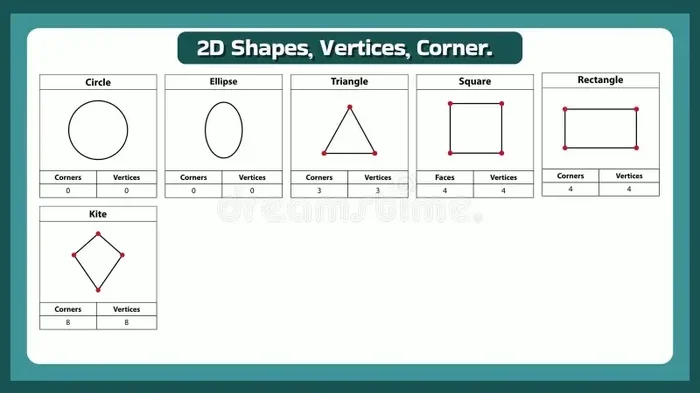

The vertices meaning is simple: vertices are the points where two or more lines or edges meet to form a corner or angle. Whether you are looking at a triangle, a cube, or a graph, vertices are the building blocks of shape and structure. This guide breaks down the vertices definition, gives you clear examples, and shows you how this concept shows up in real life.
Have you ever looked at a shape and wondered what those corner points are called? In math and geometry, those points have a specific name: vertices. Understanding the vertices meaning is one of the simplest yet most important building blocks in mathematics. Whether you are a student just starting out or someone who wants to brush up on basics, this guide covers everything you need to know.
The word “vertices” might sound fancy, but the idea behind it is really straightforward. Every shape you see around you, from a stop sign to a cardboard box, is made up of vertices. Once you know how to spot them and count them, a whole new world of geometry opens up. Let us dive in and explore the vertices definition in a way that is easy to follow.
Key Takeaways
- Vertices are corner points: They form where two or more edges or lines meet in any shape or figure.
- The singular is “vertex”: One corner point is a vertex, and the plural is vertices.
- Vertices appear in 2D and 3D shapes: Triangles have 3, cubes have 8, and pyramids vary by base shape.
- Vertices matter in graph theory: In math and computer science, vertices represent nodes or connection points.
- Real-world uses are everywhere: Architecture, gaming, design, and engineering all rely on understanding vertices.
- Common mistakes are easy to avoid: Confusing vertices with edges or faces trips up many learners.
- You can count vertices with a simple rule: For polygons, the number of vertices equals the number of sides.
📑 Table of Contents
- What Does Vertices Mean? The Simple Definition
- Vertices in 2D Shapes
- Vertices in 3D Shapes
- Vertices in Graph Theory and Computer Science
- How to Count Vertices Like a Pro
- Real-World Uses of Vertices
- Vertices and Euler’s Formula
- How Vertices Connect to Other Math Concepts
- Tips for Teaching Vertices to Kids
- Frequently Asked Questions
- Conclusion
What Does Vertices Mean? The Simple Definition
The vertices meaning in plain English is this: vertices are the points where two or more straight lines or edges come together. Think of it as the corner of a shape. When you draw a triangle, the three points where the lines meet are the vertices. That is it. That is the core vertices definition you need to remember.
The singular form of the word is “vertex.” So one corner point is a vertex, and multiple corner points are vertices. This comes from Latin, and it simply means “a turning point.” The word shows up in many areas of math, but geometry is where most people first encounter it.
Why Does the Plural Matter?
Many people get tripped up by the singular and plural forms. Saying “a vertex” for one point and “vertices” for more than one is basic but important. Using the wrong form can confuse readers and listeners, especially in classroom settings or exams. Here is a quick look at how the forms work:
- Vertex: One corner point. Example: “This triangle has one vertex at the top.”
- Vertices: More than one corner point. Example: “A square has four vertices.”
Once you lock in this simple rule, you will never mix them up again. It is a small detail that makes a big difference in how confident you sound when talking about shapes.
Vertices in 2D Shapes
Two-dimensional shapes are flat. They have length and width but no depth. Every 2D shape has vertices where its sides meet. The number of vertices always matches the number of sides in a polygon. Let us walk through some common shapes.
Triangles
A triangle has three sides and three vertices. It does not matter if the triangle is big or small, equilateral or scalene. The vertices meaning stays the same: those are the three corner points where the sides join. Each triangle always has exactly three vertices.
Squares and Rectangles
A square has four equal sides and four vertices. A rectangle also has four vertices, even though its sides are not all the same length. The corners are where the sides meet at right angles. These are some of the most familiar vertices in everyday life.
Pentagons and Hexagons
A pentagon has five sides and five vertices. A hexagon has six sides and six vertices. The pattern is clear: the number of vertices in a polygon equals the number of its sides. This rule works for every polygon, no matter how many sides it has.
Quick Tip: To count the vertices in any polygon, simply count the sides. The numbers will always match. This is one of the handiest shortcuts in geometry.
Vertices in 3D Shapes
Three-dimensional shapes add a new layer. They have length, width, and depth. In 3D shapes, vertices are still the corner points, but now edges and faces come into the picture too. An edge is a line where two faces meet, and a vertex is where edges come together.
Cubes and Rectangular Prisms
A cube is one of the most common 3D shapes. It has 6 faces, 12 edges, and 8 vertices. Every corner of a dice is a vertex. A rectangular prism works the same way. It also has 8 vertices, even though the faces are rectangles instead of squares.
Pyramids
A pyramid has a base and triangular sides that meet at a single point at the top. A square-based pyramid has 5 vertices: four at the base and one at the top. A triangular-based pyramid has 4 vertices. The number of vertices changes depending on the shape of the base.
Spheres and Cylinders
Not all 3D shapes have vertices. A sphere is perfectly round and has no edges and no vertices. A cylinder has two circular faces and a curved surface, but it also has no vertices. This is an important point to remember: curved surfaces do not create corner points.
| 3D Shape | Faces | Edges | Vertices |
|---|---|---|---|
| Cube | 6 | 12 | 8 |
| Rectangular Prism | 6 | 12 | 8 |
| Square Pyramid | 5 | 8 | 5 |
| Triangular Pyramid | 4 | 6 | 4 |
| Sphere | 0 | 0 | 0 |
| Cylinder | 3 (2 flat, 1 curved) | 0 | 0 |
| Cone | 2 (1 flat, 1 curved) | 0 | 1 |
As you can see from the table above, not every 3D shape follows the same pattern. Spheres and cylinders have zero vertices, while cones have just one. Memorizing this table can save you time on tests and quizzes.
Vertices in Graph Theory and Computer Science
The vertices meaning goes far beyond shapes on a page. In graph theory, a vertex (plural: vertices) represents a point or node in a network. This is a huge part of computer science, data analysis, and social media mapping.
What Is a Graph in Math?
A graph is a collection of vertices connected by edges. The edges show relationships between the vertices. For example, in a social network, each person is a vertex, and the connections between people are the edges. This is one of the most practical uses of the vertices definition outside of pure geometry.
Why Do Computers Use Vertices?
Computer graphics and video games rely heavily on vertices. Every 3D model you see on screen is made up of thousands or even millions of vertices. The computer uses these points to define the shape of every object, character, and environment. Without vertices, modern gaming and animation would not exist.
GPS systems and mapping software also use vertices to plot routes and define boundaries. Each point on a map can be a vertex in a larger network. This is why understanding vertices meaning matters not just in math class but in real-world technology too.
How to Count Vertices Like a Pro
Counting vertices is easier than most people think. Here are some practical steps you can follow to get it right every time.
- Identify the shape: Is it 2D or 3D? Is it a polygon or a solid figure?
- Look for corners: A vertex is always a corner where lines or edges meet. Scan the shape carefully.
- Count each corner once: Point to each corner and count aloud to avoid missing any.
- Use the polygon rule: For any flat polygon, the number of vertices equals the number of sides.
- Check for curved surfaces: Shapes with only curved surfaces, like spheres, have zero vertices.
With a little practice, counting vertices becomes second nature. Try it with objects around your house. A book has 8 vertices. A traffic cone has 1 vertex. A pizza slice (triangle) has 3 vertices. You will start spotting them everywhere.
Common Mistakes to Avoid
Even careful students make mistakes when working with vertices. Here are the most common ones:
- Confusing vertices with edges: An edge is a line. A vertex is a point where lines meet. They are not the same thing.
- Forgetting curved shapes have no vertices: Cylinders and spheres do not have corners, so they have zero vertices.
- Mixing up singular and plural: Remember: one vertex, many vertices.
- Counting the same vertex twice: Go slowly and point to each corner as you count.
Expert Insight: Many students confuse faces with vertices when looking at 3D shapes. A face is a flat surface. A vertex is a corner point. Keep these two ideas separate, and you will never mix them up.
Real-World Uses of Vertices
The vertices meaning is not just an abstract math idea. It shows up in many real-world fields that impact your daily life.
Architecture and Building Design
Architects use vertices to plan buildings and structures. Every corner of a room, every angle of a roof, and every joint in a bridge starts with a vertex. Understanding vertices helps builders create strong, stable designs.
Video Games and Animation
As mentioned earlier, 3D models in games are made of vertices. Game developers place thousands of vertices to create characters, landscapes, and objects. The more vertices a model has, the more detailed and realistic it looks.
Navigation and Mapping
Maps use vertices to define boundaries, routes, and locations. GPS systems calculate paths by working with networks of vertices. So the next time you use Google Maps, remember that vertices are working behind the scenes.
Art and Graphic Design
Graphic designers use vertices to create logos, illustrations, and digital art. Vector graphics, which are used in software like Adobe Illustrator, are built entirely from vertices and the lines connecting them. This is why the vertices definition matters to creative professionals too.
Vertices and Euler’s Formula
For those who want to go a step deeper, Euler’s formula connects the number of vertices, edges, and faces in a 3D shape. The formula is:
V – E + F = 2
In this formula, V stands for vertices, E stands for edges, and F stands for faces. This rule works for many solid shapes, especially polyhedra (shapes with flat faces). Let us test it with a cube:
- A cube has 8 vertices (V = 8)
- A cube has 12 edges (E = 12)
- A cube has 6 faces (F = 6)
Plugging these into the formula: 8 – 12 + 6 = 2. It works! Euler’s formula is a powerful tool for checking your vertex counts and exploring the relationship between vertices, edges, and faces in 3D geometry.
How Vertices Connect to Other Math Concepts
Vertices do not exist in isolation. They connect to many other math ideas that students learn over time.
Angles: Vertices are where angles form. The point of an angle is always a vertex. When two lines meet at a vertex, they create an angle. Understanding this link helps with geometry proofs and trigonometry.
Symmetry: Many shapes have symmetry around their vertices. A square has four vertices, and you can fold it along lines that pass through those vertices to see its symmetry. Recognizing this pattern makes symmetry easier to understand.
Coordinate Geometry: In coordinate geometry, you place vertices on a grid using x and y coordinates. This lets you calculate distances, midpoints, and slopes. Plotting vertices on a graph is a foundational skill for algebra and higher math.
Area and Perimeter: Knowing the vertices of a shape helps you calculate its area and perimeter. You need the coordinates of the vertices to find the exact measurements of irregular shapes.
Tips for Teaching Vertices to Kids
If you are a parent or teacher, making the vertices meaning fun and memorable is key. Here are some tips that work well:
- Use real objects: Grab a box, a ball, and a can. Ask kids to identify which ones have vertices and which do not.
- Draw shapes together: Have kids draw different polygons and count the vertices as they go.
- Play corner games: Have kids stand in a room and point to corners. Each corner is a vertex.
- Use building blocks: Blocks like LEGO or wooden blocks let kids build shapes and count vertices hands-on.
- Sing a simple rhyme: “Vertices are corners, corners are key. Count them on every shape you see!”
Making the learning process playful helps kids retain the concept longer. They will start seeing vertices in everything from picture books to cereal boxes.
Frequently Asked Questions
What is the vertices meaning in simple words?
The vertices meaning is straightforward: vertices are the corner points where two or more straight lines or edges meet to form a shape. In simple terms, they are the corners of any polygon or solid figure. The singular form is “vertex,” and the plural is “vertices.”
How is the word “vertex” different from “vertices”?
“Vertex” is the singular form, meaning one corner point. “Vertices” is the plural form, meaning more than one corner point. For example, one corner of a triangle is a vertex, while all three corners together are the vertices of the triangle.
Do all 3D shapes have vertices?
No, not all 3D shapes have vertices. Shapes with only curved surfaces, like spheres and cylinders, have no vertices because they have no corners. A cone has one vertex at its tip, and a cube has eight vertices at its corners.
What is the relationship between vertices and edges?
Vertices are the points or corners, while edges are the straight lines that connect those points. In a triangle, three edges meet at three vertices. In a cube, twelve edges meet at eight vertices. They work together to define the shape of any figure.
Can vertices be used outside of geometry?
Yes, absolutely. In graph theory and computer science, vertices represent nodes or connection points in a network. Social media platforms, GPS mapping systems, and video game design all use the concept of vertices in ways that go far beyond traditional geometry.
How can I remember how many vertices a shape has?
For polygons, the number of vertices always equals the number of sides. A triangle has 3 sides and 3 vertices. A pentagon has 5 sides and 5 vertices. For 3D shapes, use the table above or Euler’s formula (V – E + F = 2) to check your count.
Conclusion
The vertices meaning is one of those math concepts that seems simple but turns out to be incredibly powerful. From the triangle on your homework to the 3D models in your favorite video game, vertices are everywhere. Once you understand what vertices are and how to count them, you will see geometry in a whole new light.
Remember the basics: a vertex is one corner point, and vertices is the plural. Vertices form where edges meet, and they exist in both 2D and 3D shapes. Some shapes have many vertices, while others, like spheres, have none. The pattern holds true across polygons, and Euler’s formula gives you a powerful way to check your work with 3D shapes.
The real-world applications are just as exciting. Architects, game developers, graphic designers, and mapping engineers all depend on vertices every single day. By mastering this concept now, you are building a foundation that will serve you in many areas of life and learning.
So go ahead. Look around your room. Find the shapes in everyday objects. Count their vertices. You will be surprised at how quickly this knowledge becomes second nature. The more you practice spotting and counting vertices, the more confident you will become in your math skills. Keep exploring, keep learning, and let the vertices meaning click into place every time you see a corner.