

Saying minutes in Spanish is simpler than you think. You will learn how to pronounce “minutos,” use time expressions like “y cuarto” and “y media,” and count minutes from zero to sixty. This guide covers everything from basic numbers to real-life conversations, so you can tell time in Spanish with confidence.
Key Takeaways
- Core Word: The Spanish word for minutes is “minutos,” and it is easy to pronounce and use in everyday sentences.
- Time Expressions: Native speakers use phrases like “y cuarto” for quarter past and “y media” for half past to keep conversations natural.
- Counting System: Understanding Spanish numbers from one to sixty is the foundation for telling time accurately.
- Common Mistakes: Avoid translating word-for-word from English, as Spanish time-telling follows different patterns and logic.
- Practical Tips: Regular practice with real-life examples and listening to native speakers will sharpen your skills fast.
- Advanced Usage: Learn how to express duration, ask “how long,” and use minutes in casual and formal settings.
📑 Table of Contents
- How to Say Minutes in Spanish Like a Native Speaker
- Why Learning to Say Minutes in Spanish Matters
- How to Count Minutes in Spanish
- How to Tell Time Using Minutes in Spanish
- Common Mistakes When Saying Minutes in Spanish
- Practical Examples of Minutes in Spanish
- Tips for Practicing Minutes in Spanish
- Minutes in Spanish for Different Contexts
- Quick Tips to Remember
- Frequently Asked Questions
- Final Thoughts
How to Say Minutes in Spanish Like a Native Speaker
Have you ever found yourself in a Spanish-speaking country, looking at a clock, and completely blanking on how to say the time? You are not alone. Learning how to say minutes in Spanish is one of the most useful skills you can pick up, whether you are traveling, working, or just curious about the language. The good news is that it is much easier than it looks.
The word for minutes in Spanish is minutos, and once you know a few simple patterns, you will be telling time like a local in no time. This guide walks you through everything step by step. We cover pronunciation, common phrases, real-life examples, and even some tricks that native speakers use every day. By the end, you will feel confident using Spanish time expressions in real conversations.
Why Learning to Say Minutes in Spanish Matters
Time is a part of daily life everywhere. You use it to schedule meetings, catch buses, make plans with friends, and order food at restaurants. In Spanish-speaking countries, knowing how to express time is essential for basic communication. When you can say minutes in Spanish correctly, you open doors to smoother interactions and deeper connections with people.
Think about it. Imagine you are at a market in Mexico City and the vendor asks when you want to meet. Or you are in Madrid and someone tells you a restaurant opens at a certain time. If you understand Spanish time vocabulary, you will not feel lost or embarrassed. You will respond naturally and with confidence. This is why mastering minutes is such a high-value skill for any Spanish learner.
Also, many people start their language journey by learning Spanish numbers and basic greetings. Minutes fit right into that foundation. Once you know how to count to sixty, you are halfway to telling time fluently. It is a small piece of the puzzle that makes a big difference.
The Word “Minutos” and How to Pronounce It
Let us start with the basics. The Spanish word for minutes is minutos. It sounds very similar to the English word, which makes it easy to remember. Here is a simple breakdown of the pronunciation:
- Mi — sounds like “mee” in English.
- nu — sounds like “noo” with a soft “n.”
- tos — sounds like “tohs” with a soft “t” at the end.
Put it together, and you get “mee-NOO-tohs.” That is it. The word is straightforward and phonetic, which means you pronounce it exactly as it is written. This is one of the great things about Spanish. Unlike English, Spanish words are read the way they are spelled.
If you want to say “the minutes,” you would say los minutos. The word “los” is the Spanish definite article for plural masculine nouns. You will use it often when talking about time. For example, “What are the minutes?” becomes “¿Qué son los minutos?” in Spanish.
How to Count Minutes in Spanish
Before you can tell time, you need to know your numbers. Counting minutes in Spanish uses the same numbers you use for counting in general. Here is a quick guide to the numbers you will use most often.
Numbers 1 Through 15
These are the building blocks for telling time. You will use them constantly when expressing minutes:
- Uno (one)
- Dos (two)
- Tres (three)
- Cuatro (four)
- Cinco (five)
- Seis (six)
- Siete (seven)
- Ocho (eight)
- Nueve (nine)
- Diez (ten)
- Once (eleven)
- Doce (twelve)
- Trece (thirteen)
- Catorce (fourteen)
- Quince (fifteen)
Notice that quince means fifteen. This is especially important because “fifteen minutes” or “a quarter” is one of the most common time expressions in Spanish. You will hear it all the time.
Numbers 16 Through 30
Once you hit sixteen, the numbers get a little longer, but the pattern is logical:
- Dieciséis (sixteen)
- Diecisiete (seventeen)
- Dieciocho (eighteen)
- Diecinueve (nineteen)
- Veinte (twenty)
- Veintiuno (twenty-one)
- Veintidós (twenty-two)
- Veintitrés (twenty-three)
- Veinticuatro (twenty-four)
- Veinticinco (twenty-five)
- Veintiseis (twenty-six)
- Veintisiete (twenty-seven)
- Veintiocho (twenty-eight)
- Veintinueve (twenty-nine)
- Treinta (thirty)
Treinta means thirty, which is essential for saying “half past” any hour. You will also notice that numbers from twenty-one to twenty-nine are all written as one word. This is a common pattern in Spanish that you will see again and again.
How to Tell Time Using Minutes in Spanish
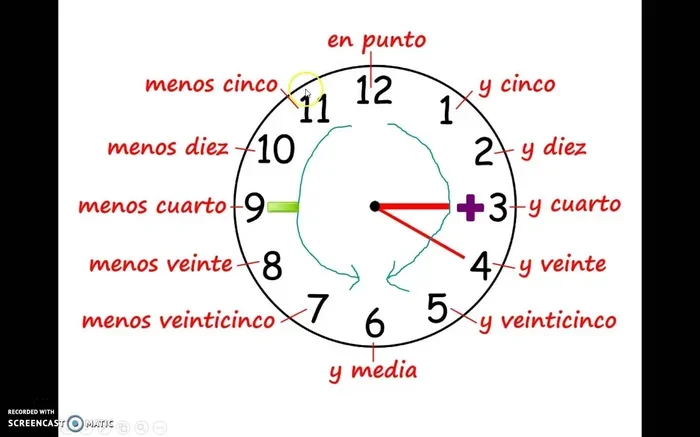
Now comes the fun part. Telling time in Spanish follows a few simple patterns. Once you learn these, you can handle almost any time of day. The basic structure is: hour + y (and) + minutes. Let us break it down.
Telling Exact Hours
When the minutes are zero, you simply say the hour. For example:
- 1:00 — Es la una.
- 2:00 — Son las dos.
- 3:00 — Son las tres.
Notice that “es la una” uses “es” because “una” is singular, while all other hours use “son” because they are plural. This is a small detail, but native speakers notice it. Getting it right shows that you understand the language deeply.
Telling Minutes Past the Hour
For minutes after the hour, you use the word “y,” which means “and.” The format is: hour + y + minutes. Here are some examples:
- 1:15 — Es la una y cuarto. (One and a quarter.)
- 2:10 — Son las dos y diez. (Two and ten.)
- 3:30 — Son las tres y media. (Three and a half.)
- 4:45 — Son las cuatro menos cuarto. (Four minus a quarter.)
Wait, did you notice that last one? In Spanish, people often count minutes until the next hour instead of minutes past the current hour. So 4:45 becomes “four minus a quarter” rather than “four forty-five.” This is a unique feature of Spanish time-telling that surprises many learners.
Key Time Phrases You Need to Know
Here are some essential phrases that will make your time-telling much more natural:
- Y cuarto — quarter past (literally “and a quarter”)
- Y media — half past (literally “and a half”)
- Menos cuarto — quarter to (literally “minus a quarter”)
- En punto — exactly on the dot (e.g., “at three o’clock”)
- Pasado — past (used in some regions)
- Para — to (used in some regions for time before the hour)
Using these phrases correctly will make your Spanish sound much more authentic. Instead of saying “son las tres y quince,” you can simply say “son las tres y cuarto,” and native speakers will understand you instantly.
Common Mistakes When Saying Minutes in Spanish
Every language learner makes mistakes, and that is perfectly fine. But some errors come up again and again when people try to say minutes in Spanish. Here are the most common ones to watch out for.
Mistake 1: Translating Word for Word from English
In English, we say “twenty-five minutes past three.” In Spanish, you would say “las tres y veinticinco.” You do not need to say the word “minutes” every time. The context makes it clear. Adding extra words can make your Spanish sound awkward and unnatural.
Mistake 2: Forgetting Gender Agreement
Spanish nouns have gender, and “minutos” is masculine. This means you need to use masculine articles and adjectives. For example, you would say “los minutos” (the minutes) not “las minutos.” This might seem small, but it matters for sounding natural.
Mistake 3: Using 24-Hour Format Incorrectly
In many Spanish-speaking countries, the 24-hour clock is common. So “15:00” is “las quince horas” or simply “las tres de la tarde.” If you are not used to this, it can be confusing at first. Practice both formats to feel comfortable in any situation.
Practical Examples of Minutes in Spanish
The best way to learn is by seeing how minutes are used in real conversations. Here are some practical examples you can use today.
Example 1: Making Plans
Let us say you want to meet a friend at ten fifteen in the morning. In Spanish, you would say:
“Quedamos a las diez y cuarto de la mañana.”
This translates to “Let us meet at ten and a quarter in the morning.” Notice how “y cuarto” replaces “fifteen minutes.” This is the natural way native speakers express it.
Example 2: Asking How Long Something Takes
If you want to ask “How long does it take?” you would say “¿Cuánto tiempo toma?” But if you want to specify minutes, you can say “¿Toma cuarenta minutos?” which means “Does it take forty minutes?”
You can also use the phrase “durante” to talk about duration. For example, “Estudia durante treinta minutos” means “She studies for thirty minutes.” This is a great structure to add to your vocabulary.
Example 3: Talking About Schedules
If you are discussing a schedule, you might say “El autobús sale a las siete y media,” which means “The bus leaves at half past seven.” Or “La clase empieza a las nueve en punto” means “The class starts at exactly nine o’clock.”
These phrases come up constantly in daily life. Whether you are reading bus schedules, setting alarms, or making dinner plans, knowing how to express minutes will serve you well.
Tips for Practicing Minutes in Spanish
Learning how to say minutes in Spanish is not just about memorizing words. It is about building habits. Here are some practical tips to help you practice effectively.
Tip 1: Set Your Phone to Spanish
One of the easiest ways to practice is to change your phone’s language settings to Spanish. Every time you look at the time, you will see the hours and minutes in Spanish. This constant exposure helps reinforce your learning without any extra effort.
Tip 2: Practice with a Partner
Find a language partner or tutor and practice telling time together. Take turns asking “What time is it?” and responding with different times. You can also practice saying what time common activities happen, like “I wake up at seven” or “I eat lunch at twelve.”
Tip 3: Listen to Native Speakers
Listening is one of the most powerful ways to improve. Watch Spanish TV shows, listen to Spanish podcasts, or follow Spanish-speaking creators on social media. Pay attention to how they express time. You will pick up natural rhythms and expressions quickly.
Tip 4: Use Flashcards for Numbers
Since minutes rely on numbers, flashcards are a great tool. Write the number on one side and the Spanish word on the other. Review them daily, and within a few weeks, you will know all the numbers from one to sixty by heart.
Minutes in Spanish for Different Contexts
Depending on the situation, you might need to use minutes in slightly different ways. Here is how the word and its expressions shift across contexts.
Formal Contexts
In formal settings like business meetings or official announcements, you will often use full sentences. For example, “La reunión comienza a las diez y cuarto” (The meeting starts at ten fifteen). The language is clear and precise, and there is no need for slang or shortcuts.
Casual Conversations
In casual settings, native speakers often shorten expressions. Instead of saying “son las cuatro y veinte,” someone might just say “son las cuatro y veinte” or even “las cuatro veinte.” Both are perfectly acceptable and widely used in everyday speech.
Cooking and Recipes
If you love cooking and follow Spanish recipes, you will often see times like “cocine durante veinticinco minutos” (cook for twenty-five minutes). This is a practical use of minutes that you can apply right away in your kitchen.
Quick Tips to Remember
- Minutos is the Spanish word for minutes. Pronounce it “mee-NOO-tohs.”
- Use “y cuarto” for quarter past and “y media” for half past.
- For times like 4:45, say “menos cuarto” (minus a quarter) instead of counting past the hour.
- Keep your sentences short and simple when telling time.
- Practice by setting your devices to Spanish and listening to native speakers daily.
- Do not translate word for word from English. Let the Spanish patterns become natural.
Frequently Asked Questions
What is the Spanish word for minutes?
The Spanish word for minutes is “minutos.” It is pronounced “mee-NOO-tohs” and is used in almost all time-related expressions. You will hear it constantly in everyday conversations, from scheduling meetings to cooking recipes.
How do you say “quarter past” in Spanish?
You say “y cuarto” to express quarter past the hour. For example, 2:15 is “las dos y cuarto.” This phrase is one of the most common and useful time expressions in Spanish, and native speakers use it every day.
Do Spanish speakers use the same numbers for minutes as for counting?
Yes, the numbers used for minutes are the same as the general counting numbers in Spanish. You just need to know the numbers from one to sixty, and you can express any minute value. Practice the numbers first, and telling time will follow naturally.
Is there a difference between “minuto” and “minutos”?
Yes, “minuto” is singular (one minute) and “minutos” is plural (multiple minutes). You use “minuto” when referring to a single minute, like “espera un minuto” (wait one minute). For anything more than one, you use “minutos.”
How do native speakers say times like 1:45?
Native speakers often say “las dos menos cuarto” for 1:45, which means “a quarter to two.” This is a very common pattern in Spanish where you count backward from the next hour. It might feel unusual at first, but it becomes second nature with practice.
Can I use “minutos” to ask how long something takes?
Absolutely. You can say “¿Cuánto tiempo toma?” or be more specific with “¿Toma treinta minutos?” (Does it take thirty minutes?). Using “minutos” in questions about duration is natural and widely understood across all Spanish-speaking regions.
Final Thoughts
Learning how to say minutes in Spanish is one of those small wins that makes a big difference in your language journey. It might seem like a simple topic, but it touches almost every part of daily life. From catching a bus to making dinner plans, knowing how to express time keeps you connected and confident.
The key is practice. Use the numbers, memorize the key phrases like “y cuarto” and “y media,” and start telling time out loud every day. Soon, it will feel completely natural. You will not even need to think about it. And once you master minutes, you will be ready to tackle more advanced Spanish topics with ease.
Keep going, keep practicing, and remember that every minute you spend learning brings you closer to fluency. The Spanish-speaking world is waiting for you. ¡Buena suerte!



